When the Moon Plays Its Magic
You notice it first in the way the air seems to thicken before sleep, as if the night has slipped a letter under your door and run away barefoot. Eclipse season does that – tips the lamp, bends the shadows, stitches a silver lining through your dreams. You turn off your phone, close your eyes, and the inner cinema blooms bigger than usual: colors deeper, faces clearer, symbols delivering themselves with shy precision. Eclipses, whether solar or lunar, tend to stir the sediment of memory; not just last week’s coffee chat, but the shelved polaroids of your life – grainy, honest, no filter but time. Even if you haven’t tracked the lunar calendar, your bones often know: the tides inside rise and touch the edges of old rooms.
Think of the Moon as a tireless mail carrier, circling the neighborhood of your heart every month. Most nights are postcards from everyday streets: the plant that’s grown two new leaves, the conversation you wish had gone differently. But in eclipse seasons, the mailbox overflows. Suddenly, one postcard is sealed with stardust. Another hums. A third smells faintly of cedar, like a memory you swore you’d lost. You wake with a sentence in your mouth or a location pin dropped in your chest – “find the green coat,” “call your brother,” “go back to the old field.” Eclipse energy isn’t about doom or neon predictions; it’s a high tide of pattern and poignancy. The Moon, in shadow or spotlight, hovers like a librarian whispering, “The book you need is shelved behind the one you always reach for.”
And yes, there’s a gentle tug-of-war here – between what you expect and what insists on being remembered. The old idea that dreams are just brain-cleaning misses their curious choreography during eclipse time. Here, symbols behave like homing pigeons. They know the way back. They know what you promised yourself at fifteen. They know where the key fell between moonlight and rug fringe. There’s nothing to force. Just receive the envelope, trace the stamp, feel the pulse of ink on the page. You’re not being haunted; you’re being addressed.
Eclipse Season: The Dream Catalyst
Here’s the thing about eclipses: they’re celestial edits, scene cuts in the ongoing film of meaning. An eclipse is when the Sun, Moon, and Earth line up to throw dramatic light or velvet shadow, and that simple choreography seems to wake up the inner theater. Many traditions have called eclipses gateways, bells, omens; in a softer key, you can think of them as dimmers and spotlights, making some themes glow while others recede to the wings. During these intervals, dreams don’t just speak; they bring props. They borrow costumes from your childhood, rearrange the furniture of your memory, and slip a present-tense ribbon around it all.
You might dream of a salt-wet pier that you haven’t seen since you were eight, waves slapping the pylons like applause. The next day, you’re cleaning a drawer and out slides a polaroid: you on that pier, red scarf, gull mid-flight, your father’s handwriting on the back – “Hold steady.” That’s eclipse season’s calling card: emotional synchronicity. It’s not proof in a courtroom sense; it’s resonance, like humming a note and hearing the room sing back. If a dream shows up twice in different clothes – a stranger with your grandmother’s smile, a house you never lived in but know like skin – it’s usually pointing to a live wire. Touch it carefully. Listen for the soft crackle.
People often ask, “How do I tell the difference between a busy dream and a meaningful one?” In eclipse time, look for the stardust postmark: a sense of timing that feels unlikely, a symbol that repeats across days, a small discovery in waking life that clicks into place like a puzzle piece you didn’t know you were missing. One more tip: pay attention to what changes in the dream. Doors that used to be locked, now ajar. A train you always miss, finally waiting. Movement matters. Eclipses are not just mood – they’re momentum. Even a tiny shift hints at a corridor opening.
If you wake shaky, don’t panic. Sometimes the nervous system quivers when the heart says yes. Drink water. Sit by a window. Ask the dream, “What do you need me to carry into daylight?” The answers, if any, will be brief and clear – one sentence, one image, one scent. That’s enough to begin.
Runes: The Cosmic Postcards
If dreams are lunar letters, runes are the postmarks that confirm delivery. Runes – those ancient characters carved on wood, stone, or bone – carry archetypal meanings much like the major chords of a song. In eclipse season, drawing a rune is less like pulling a random tile and more like asking the cosmos to circle a word in your dream’s paragraph. Think of each rune as a short, potent sentence: Fehu whispers about resources and flow; Ansuz speaks of messages and breath; Raidho suggests the right road revealing itself underfoot. You don’t have to memorize a library of lore. Hold the shape in your palm, say its name aloud, notice what your body does. Warmth? Resistance? A quiet yes behind the ribs?
Let’s say you dreamed of that ancient forest path under a blood moon, bark damp with time, the hush so rich you could taste it. The next day, you pull Perthro – the rune of the cup, the lot-cast, the mystery that tips out secrets when it’s ready. Suddenly the dream isn’t just a pretty film; it’s a conversation about hidden lineage, unopened boxes, the chance element that isn’t really chance. Or maybe your dream was a house with a pulse, lights blinking in a strange Morse code. You draw Sowilo – the Sun – suggesting clarity and life force. The message shifts from “What’s wrong with this house?” to “Where does the light want to go?” Runes don’t tell you what to do; they underline what is speaking.
A small, steady way to work: after a vivid dream, breathe with it for a minute, then draw one rune. One is plenty. Ask for a single thread to follow, not the whole tapestry. The rune becomes a traveling companion, a lantern carried beside the dream as you move through your day. You might see its shape echoed in spilled tea leaves, a street crack, the logo on a bus – these echoes are not coincidences to hoard; they are timestamps of attention.
When your mind scrambles for certainty, let humor in. “Oh, of course it’s Hagalaz, the hailstorm,” you might sigh, just as your plans go sideways and a better route appears. If a rune feels thorny, thank it anyway. Thorns guard roses. During eclipses, the trickster shows up wearing formalwear; the awkward moment might actually be your invitation to step through a more elegant door.
Interviewing Your Dreams, One Postcard at a Time
Try meeting your dreams like a curious journalist whose notebook smells faintly of moonlight. Give them thoughtful questions and room to answer. Here’s a simple interview-style approach you can use when eclipse season paints the nights in saturated tones.
- What’s the headline of this dream? If a newspaper had to title it in six words, what would they be?
- Who is the main character? If it’s not you, how does this character move, sound, decide?
- Which object kept insisting on being seen? A key, a bell, a jar of sea glass? Objects in eclipse dreams are often hyperlinks: you click them, and a memory opens.
- Where did time slow down? That’s usually the scene the dream wants circled in red.
- Which rune would you hire as an editor for this dream? Draw it, or if you don’t have a set, imagine a single word-rune that chooses you: “flow,” “gate,” “home,” “no.”
Let’s weave a composite from readers who wrote in this week. Mira, 26, keeps dreaming of a bus with no driver that knows every stop. When she draws Raidho, she laughs – of course it’s the travel rune. But the real turn comes when she checks an old wallet and finds a transit card from a city she left abruptly years ago. “I thought I’d lost that version of me,” she says. Another reader, Jonah, 41, dreams of a library with all the spines turned inward. He pulls Ansuz – language, breath, guidance – then a day later hears an old voicemail from his grandmother, the one who taught him to read. He presses play and feels the stacks turn outward one by one.
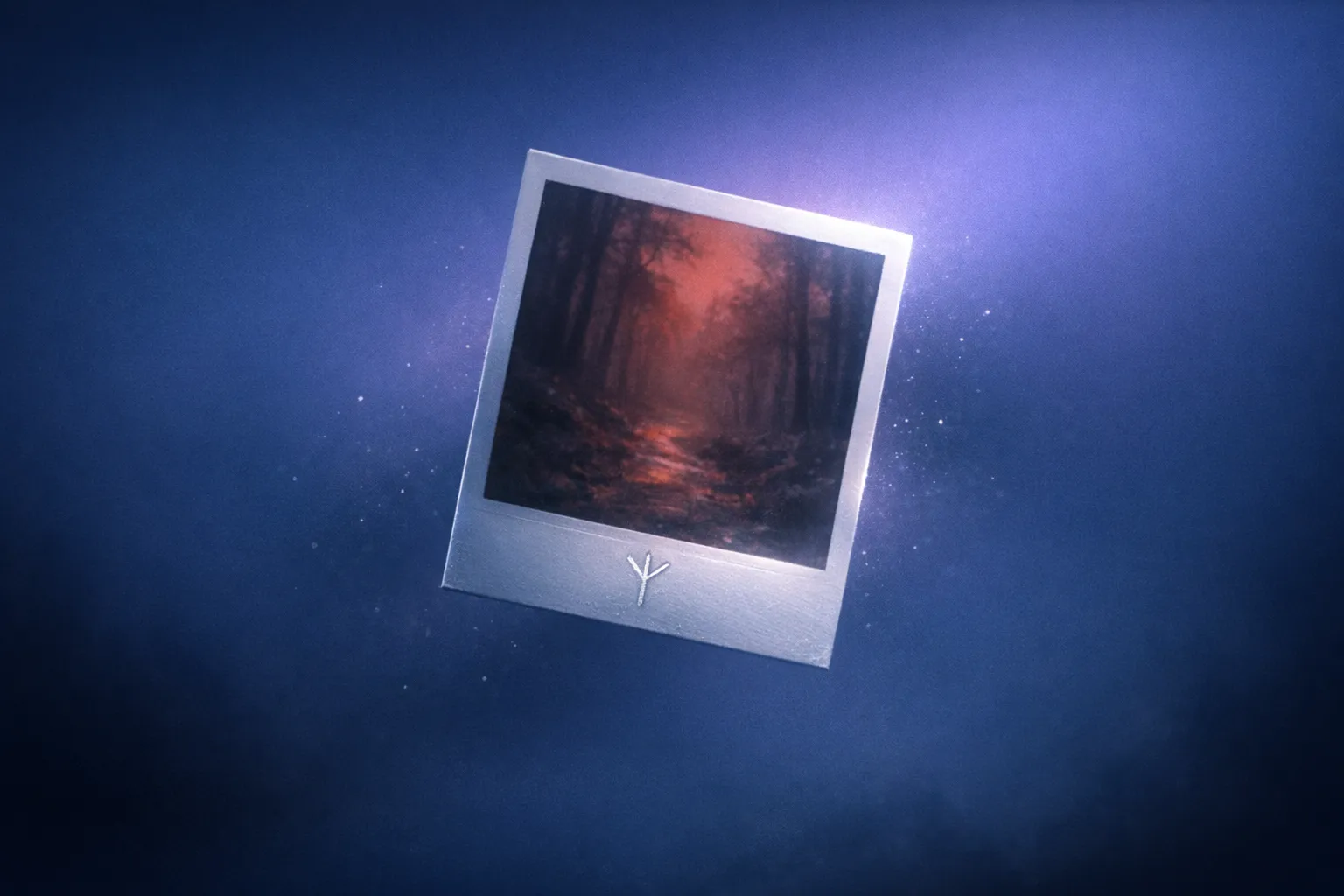
And then there’s the anchor example that keeps visiting you: a blood-moon forest path glinting with old sap, and two days later, a polaroid slides from a shoebox – same path, smaller you, the caption “Find your way back.” You ask the image, “Back where?” and draw Eihwaz – the yew tree, hinge of endurance and transformation. Maybe “back” is not a location but a spine. Maybe the path isn’t behind you, but inside you.
When the interview winds down, thank the dream like a source who shared a delicate quote. Most interviews are not exposés; they’re mirrors. Trust that one well-phrased question can change the whole article of your day.
Timing the Memory: Eclipse Clocks, Rune Hands
There’s an art to timing memories, to knowing when to re-open a box and when to let it rest in its dust-mote cathedral. Eclipse seasons act like grand clocks: the chime grows louder around the nodes of your life – the places where your storyline hooks into other storylines. Think of the eclipses as clock faces and the runes as moving hands that point to “now,” “not yet,” or “almost.” You don’t need a spreadsheet of the sky to sense it. Your body keeps exquisite time. If your throat tightens around a name or your palms warm when you pass a certain street, the clock may be striking.
Here is a short sequence to honor the moment a memory asks for daylight:
- Title it. Write a four-word caption for the memory as if it were a polaroid. Short keeps it honest.
- Pair it. Draw one rune to sit beside the caption. If none is at hand, draw a simple line shape that feels right. Let the hand-drawn mark be your rune.
- Place it. Put the caption and rune under something weighty (a book, a stone) overnight. This lets gravity bless the recall.
- Revisit. In the morning, ask, “Do I act, archive, or simply witness?” Not every memory needs doing. Some just want fresh air.
Notice how the world answers. The song in the café, the sentence on a billboard, the way a child on the bus looks exactly like your cousin when you were both eight. Serendipity during eclipse windows is a feedback loop; it’s the universe murmuring, “Yes, you’re on the right page,” or “Try the next shelf.” If you feel stuck, consider booking a gentle check-in – a simple psychic reading can be like asking the librarian for the shelf number when you’re tired of wandering the aisles.
A myth worth loosening: that closure is a slammed door. During eclipses, closure often looks like a window opened an inch farther, enough to change the air. Another myth: that we must excavate every sorrow to grow. Sometimes, the rune says no. Isa, the ice, asks for stillness. Let the lake freeze. Walk its surface. Watch the moon skim the diamond skin.
When the season ebbs, you’ll notice the dreams soften their edges again. The mailbox light clicks off. But the postcards you kept – those phrases, those rune-inked captions – remain living corners in your home. Tuck them into books. Slide one near your mirror. Tape another inside a kitchen cabinet so the steam can bless it each morning. Memory is a wild animal that comes closer when you stop chasing it and simply sit, palms open, listening for soft paws on the path. Keep a pen by the door. The Moon will knock again.

