The Echoes of the Past
Here’s a surprising fact to open the door: in many traditional astrologies, the South Node isn’t a planet at all – just a mathematical point where the Moon’s path crosses the Sun’s. Yet this invisible hinge often swings the heaviest doors in your story. You feel it as a tug, a cadence, a rhythm you’ve known before. And when it’s activated by a transit (that’s when other moving planets make contact with it), you might encounter a strange echo in your day, or a dream so familiar it makes your bones hum. The South Node whispers of the skills you’ve mastered, the patterns you’ve worn threadbare, and the karmic muscle memory that keeps your steps so sure you don’t even notice you’re walking.
Now, let’s borrow a ladder as a metaphor – a ladder of soft wood and old paint, propped in a quiet hallway of your psyche. Each rung is a phase of recognition. Sometimes your foot slips and you laugh; sometimes you pause, hearing voices that aren’t quite voices. The South Node doesn’t demand; it tempts with ease. You know how to be this person. You know this script. You can climb this ladder blindfolded. But ease can be a spell as much as a comfort, and the spell often becomes visible first in your dreams.
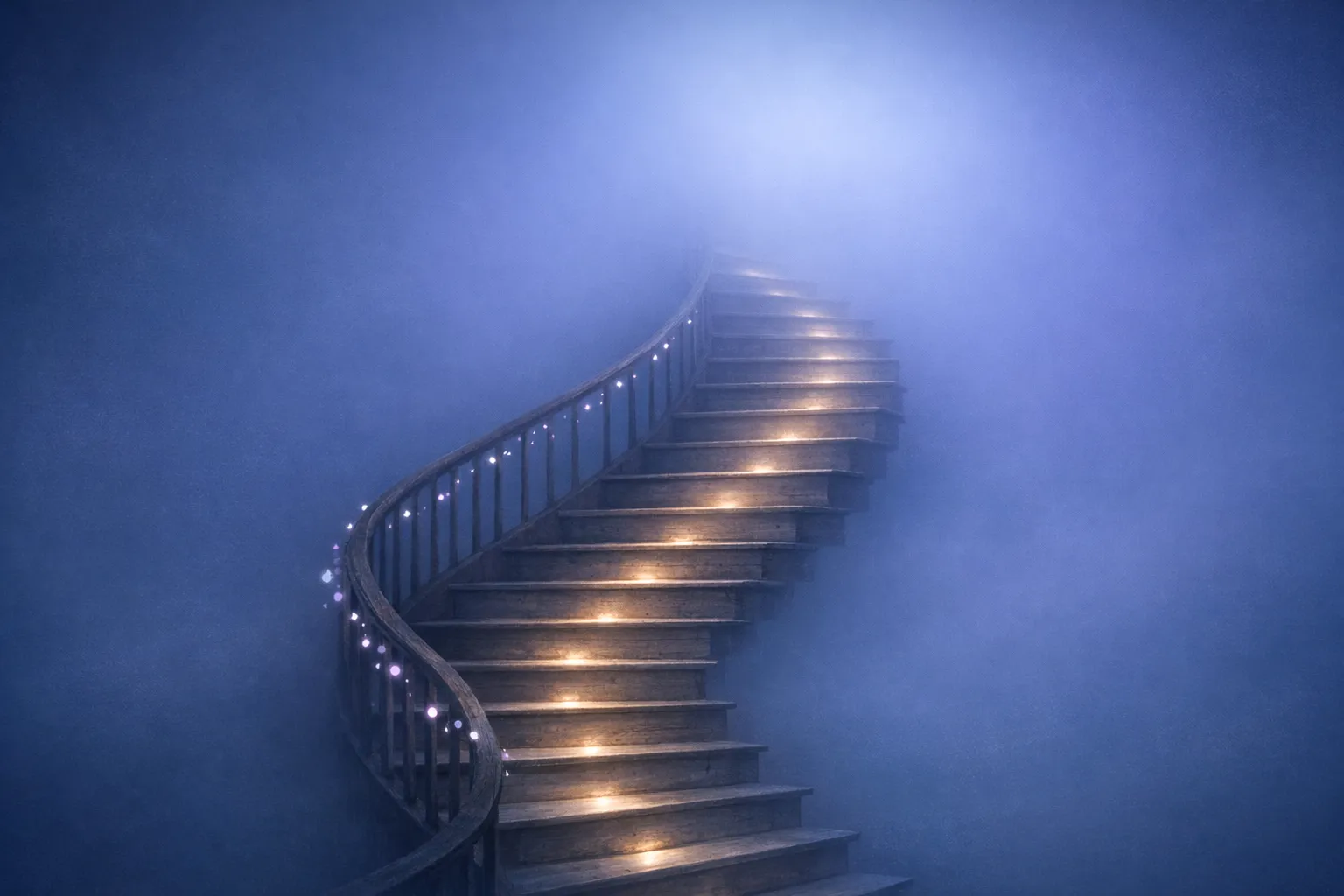
Imagine a recurring dream about ascending an endless, creaky staircase, each step resonating with a familiar but distant feeling of déjà vu. The steps feel like memories – textured, specific, creaking in the same places. Somewhere above, a light smears like dawn through frosted glass. You never quite reach it, but you keep climbing because your body already knows this choreography. In waking life, this can look like stepping into the same roles at work, the same arguments with a partner, the same self-doubt parading as humility. The dream unfolds as a secret rehearsal: here’s how you keep doing it; here’s how it keeps feeling.
Rather than pathologizing that repetition, you can treat it as a breadcrumb trail. The South Node proposes that every repeated scene offers a gift wrapped in old fabric. Your task is not to torch the costume trunk but to decide, rung by rung, what still fits and what pinches. You are not erasing a past life; you’re learning where the past-life staircase leads when you glance over your shoulder and smile.
Descending Dreams: Staircases as Symbols
Staircases are stage sets for movement – up, down, around the bend. In dreams, they are literal architecture for inner change. When you descend, you enter basements of memory, old cellars where jars of last season’s fruit still glow. When you ascend, you reach attics where forgotten trunks live, full of vintage selves. The sensation of climbing without end suggests a narrative loop: you’re compelled to return to a feeling until you’ve learned its music. In astrology’s intuitive language, the South Node often composes that refrain: the familiar role, the comfortable struggle, the talent you don’t need to think about.
There’s a reason stairs feel ceremonial. Each rise demands a small ritual of effort; each landing delivers a perspective you couldn’t have had down there. Dream-time stairs will sometimes narrow, coil, or sprawl into hotel lobbies and empty schools – settings that hint at the social places where your patterns play out. A gilded theater staircase may point to performative habits; a cluttered tenement stair could nod to survival skills that once saved you but now crowd your present. If the rail is missing, you meet the edge of your trust. If a step collapses, you find the part of your story you no longer wish to carry.
Here’s a gentle way to listen to these dreams: imagine your staircase as a ladder lying along your timeline, each rung a season of your becoming. Where is the worn wood? Where is the splinter? What step feels newer, brighter, untested? The image helps you ask refined questions: “Where am I rushing upward to avoid feeling?” or “Which basement room holds a treasure I keep ignoring?” In truth, many staircase dreams are invitations not to choose only up or down but to feel the purpose of both. Descending can retrieve wisdom; ascending can air it out in the sunlight.
A quick note on déjà vu: that electric ripple isn’t always a sign of fate so much as attention snapping awake. The South Node loves déjà vu because it’s half memory, half magnet – your psyche recognizing an old pattern co-starring in a brand-new scene. The hint is gentle, the echo delicate. You can respond with curiosity: not “Why again?” but “What nuance is different this time?”
South Node: Unlocking Your Celestial Footprints
The South Node marks a set of footprints you arrived with – the grooves your soul’s shoes already made, whether you frame that as literal past lives or simply inherited memory and deep habit. In your natal chart, it sits opposite the North Node, like two points on a seesaw. The South Node gifts you fluency: capacities you don’t remember learning, attitudes that feel native, ways you navigate life without a map. The North Node invites growth; the South Node offers the seasoned traveler you’ve already been. When transits touch your South Node – by conjunction, square, or trine if you like to track the geometry – life tends to uncork a note of recognition. People re-enter, old interests step forward, or dreams crank the projector on scenes you thought were wrapped.
Consider a period when Venus crosses your South Node: affection and aesthetics with a vintage flavor. You might pull a box of letters from a closet, or your taste shifts to music you loved ages ago. If Mars activates it, the heat rises around old conflicts or old courage; you may take decisive action using methods that once worked perfectly, but need an update. With Mercury, the messenger, you may revisit a conversation that begs for better words – maybe in dreams that rehearse what your waking self is ready to say. And Saturn? He’s the architect tapping the staircase with a level, asking: which steps are sound, which need reinforcement, which must be replaced?
There is a sweet paradox here: you don’t have to abandon the South Node to grow. You only need to become choosy about which of its offerings still serve. The mistake is thinking the South Node is a problem. It’s not. It’s a toolbox – but some tools are museum pieces, others trusty companions. Transits are like curators staging a new exhibit from familiar objects so you can see them with fresh eyes. When you notice a tide of coincidence, a sudden streak of “old you,” or a poignant, recurring dream, ask: what is being staged? What room of the museum am I walking into right now?
If you track astrology lightly, you can mark the dates when a planet meets your South Node by degree. If you prefer an intuitive path, you can let your dreams do the calendar work. A sequence of staircase dreams often signals a season of reorientation. The landings – those pauses between flights – become your checkpoints: a conversation, a move, a revision to your bio, a name you reclaim or release. Each landing whispers: keep the craft, shed the compulsion.
Karmic Footsteps in the Present Tense
Karma, in this context, is less a cosmic scoreboard and more a choreography of cause and effect. Your South Node isn’t punishing you; it’s reminding you of dances you’ve learned by heart. In some lives – real or metaphorical – you might have been the archivist, the caregiver, the fighter, the mystic, the entertainer. You carry those traces. The present asks: which steps belong in today’s routine? Picture a ladder again, this time lying across a river. Every rung you step on brings you to the next bank. You don’t have to carry the whole ladder with you – just cross.
Because the psyche speaks in symbols, let’s lean into a simple, friendly practice to translate your staircase dreams into daily movement. This is less prophecy and more poetry – something you can try over a week:
- Upon waking, sketch your staircase from the dream. Don’t worry about accuracy; lines and arrows are fine. Note any details: handrail, material, who else was there.
- On a sticky note, write the single emotion that defined the dream step you remember most. Place it somewhere you’ll spot mid-day.
- Choose one action that echoes the energy of “ascending” or “descending.” Ascending action: send a message, apply, propose, show up. Descending action: archive, forgive, restock, return. Do it before sunset.
- In the evening, jot one sentence: “Today’s rung taught me…” Accumulate seven sentences. On the eighth day, read them as a poem.
This tiny ritual reframes your staircase from an endless loop into a living ladder of discovery. And you’ll notice the body understands before the mind catches up. You might stand taller during ascending days; you might breathe deeper on descending days. The South Node nods approvingly: see, you already knew this, we’re just polishing the knowing.
If you’re approaching a particularly loud season – say, eclipses near your Nodes – remember that echoes get stronger in cathedrals. People enter who sound like pages from old chapters. Your task is discernment, not defense. Gesture a thank-you to the skills that rise. Borrow them, reshape them, then set them back where they belong.
– Mini-break: Myth vs. Reality – Myth: The South Node is a trap you must escape. Reality: It’s a gift chest with a wobbly lid. Open it, take what’s still gold, stabilize the hinge, and leave the rest.
Ladders Through the Dream-House: A Step-by-Step Walkthrough
Let’s walk gently through that anchor dream, step by step, and translate it in the language of the South Node. You’re on the first step of an endless, creaky staircase. The creak is the past speaking. It’s not trying to frighten you; it’s reminding you where the wood is stressed. Put your weight there mindfully. In waking life, locate a familiar stress point – maybe your habit of volunteering before you’re asked, or your reflex to undercut a bold idea with an apology. That creak marks a choice: repeat, or redistribute your weight.
Second landing: a dim bulb overhead. Light in dreams is awareness. If it’s weak, you might be leaning on old instructions written for a different era of your life. Replace the bulb by updating a story about yourself. For instance, “I’m the dependable one” can become “I’m dependable when it’s healthy, and I delegate when it’s not.” This is a South Node refinement – not a disowning.
Third flight: a banister carved with motifs you recognize. These carved patterns are your ancestral or collective scripts. Perhaps your family spoke effort as love, or silence as safety. Touch the banister. Notice what it offers (grounding, heritage) and where it splinters (obligation, secrecy). Keep the lineage strength; sand the splinters with a boundary.
Fourth landing: a door you pass but don’t open. Doors in stair dreams are invitations to side stories. If the door feels charged, that’s a pocket of South Node brilliance waiting – maybe a language you once loved, a craft, a sport, a kindness. You don’t have to enter today. Make a date with that room this month: a class, a call, an hour with supplies.
Fifth flight: the déjà vu swells. Here’s where a South Node transit might be live in the sky. You find yourself saying, “I knew this was coming.” Let that sentence ease your shoulders. Familiarity is a tool; it gives you time to choose. What one variable can you shift now? Tone? Timing? Partner? If you always go alone, bring a companion. If you always rush, pause on the landing and listen to the house breathe.
Top? In the truest staircase dreams, there often isn’t a top – because the point isn’t reaching a final floor. It’s the deepening relationship with each step. You are learning the architecture of your past-life patterns well enough to improvise. And improvisation is where the North and South Nodes shake hands: talent meets curiosity, history meets horizon.
If at any point you want a mirror held up kindly – another set of eyes on the rungs you keep touching – you might consider a brief psychic reading as a way to reflect the symbols you’re already receiving. Not as an oracle to outsource your choices, but as a conversation partner for the melodies echoing through your staircase. Then, whether you’re lingering on a landing or sprinting two steps at a time, your awareness becomes the handrail that never wobbles.
One last image to pocket: imagine your life as a dream-house with ladders tucked cleverly in corners – behind the bookcase, near the pantry, out on the balcony. Each ladder leads somewhere slightly shifted in perspective. When your South Node calls, you don’t have to make a grand exit. You can simply climb one quiet rung, peer around, and decide. This is the art: to recognize the echo, to answer with presence, and to keep moving – up when insight wants air, down when wisdom wants rest, sideways when a new room calls your name.

