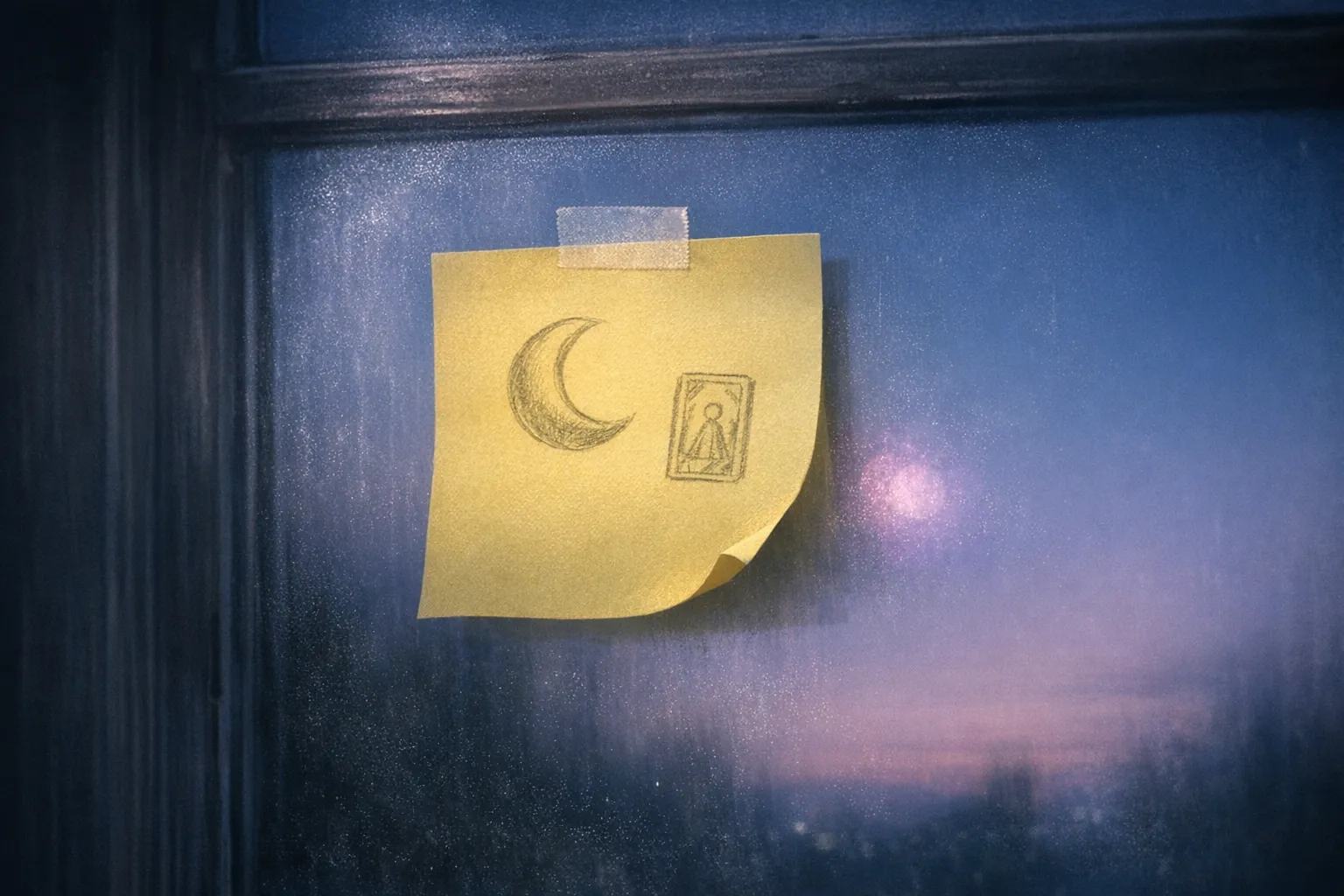
Whispers of the Waning Crescent
The night is almost out of ink. Somewhere a streetlight hums, and the moon – thinner than a thumbnail – rests like a closing parenthesis at the edge of the sky. You’re by the window with a yellow Post-It, the kind meant for grocery lists and desk reminders, but tonight it’s a small sail for a longer journey. You write a wish, something brave in plain words. The paper is ordinary. The feeling is not. You stick it to the corner of the windowpane as if you’re mailing it through the glass, trusting the last light to stamp and send it.
The waning crescent is the moon’s hush before reset. If the full moon is a brass band, this phase is the quiet hallway after the concert when you can hear your own shoes. It’s a time for release, clarity, and tender planning – the composting of what you no longer need into fertile soil for what you do. Think of it as the garden bed after harvest: not empty, just receptive. Even if astrology is simply a language of timing and symbol, this particular symbol is powerfully intuitive. It says: set down the heavy bag, keep the key, choose the doorway.
Using Post-Its here is delightfully practical magic. You take one idea, stick it where you’ll see it, and let it call its future home. Your future self isn’t a stranger; it’s a seed already sprouting in the dark. When you write during the moon’s thinning light, you’re not begging the sky for favors – you’re making a capsule of clarity. The waning crescent helps you decide which seeds to save and which husks to scatter.
Tonight, you don’t need mystery objects or long rites. You need a pen, a note, and a gentle question: What can end so something truer can begin? Let the answer be small and exact. “I release rushing. I invite good timing.” Or “I send courage to the version of me who signs the form.” Your words are envelopes; your breath is the stamp; the moon is the sorting room that knows exactly where they go.
The Moon’s Soft Echo: Understanding Its Phases’ Power
We live in cycles, whether we’re moon-watching or just following the rhythms of our own mornings. The moon’s phases are like chapters, each with its own tone. New Moon: blank page, seed pressed into dark soil. Waxing: growth, scaffolding, errands, plans. Full Moon: spotlight, harvest, aha. Waning: composting, clearing drawers, making room on the shelf. The waning crescent, just before the slate wipes clean, is the softest echo – the time when intuitive nudges feel like warm drafts under a door.
If “retrograde” means a planet appears to move backward (and we rethink, revise, re-do), the waning crescent is the pause before “go,” the breath after “out.” It’s a perfect phase for private rituals that don’t need applause. Your inner ear is keen, the outer noise is dim. You can sense which desires are truly yours and which were borrowed from other people’s calendars.
Here’s a way to map it: imagine your intentions as seeds in a jar. During the full moon, you hold the jar up and admire. In the waning days, you decide which seeds are viable. You run them through your fingers and feel their weight. You may let some go – not as a loss, but as an act of devotion to the ones that will actually sprout. This is where Post-It prayers feel especially truthful. They’re quick, portable, and honest. You’re not chiseling a monument; you’re tagging a seed packet: “Plant me after the first rain.”
Astrology, at its friendliest, is a clock you can feel. You don’t have to believe anything mystical to notice you’re bolder at some times of the month and reflective at others. The waning crescent invites you to lower your shoulders and listen. If the moon were speaking, it might say: try fewer words and better ones. And if your nervous system could reply, it might say: thank you. That’s the power here – not an external command, but an inner permission slip. Write the wish. Be precise. Love the pause.
Post-It Magic: Communicating Across Time
Let’s turn this into a simple practice you can actually do – no velvet table required. You, your pen, your small square of sunshine paper, and a willingness to mail something to your future self.
Step 1: Choose your window of quiet. Aim for the last three days before the New Moon. This is prime whisper-weather. If you don’t track exact dates, step outside at night: if the moon is a thin smile or hidden, you’re there.
Step 2: Pick one wish, not five. A wish is not a grocery list; it’s a message in a bottle. Make it specific and speak to your future self directly. “Dear Future Me, may we find the right words in next month’s interview – and the right pause between them.”
Step 3: Add tarot timing. Tarot timing is a playful way to set a heartbeat for your wish using the suits. Wands = weeks, Cups = the next meaningful connection or emotional tide, Swords = a clarity moment, Pentacles = months or concrete milestones. Draw one card. If you pull the Three of Wands, read it as “in about three weeks, something expands.” If you pull the Page of Pentacles, expect a tangible first step to show up in the coming month or through study or practice. If you don’t use cards, assign your own timing based on the suits’ feel: fire is fast, earth is steady.
Step 4: Write it like a postcard. Keep the language simple, rooted. “I release the fear of asking. I welcome a warm yes by the second week of next month.” Sign it with your initials and today’s date, like you’re signing the wall of your life.
Step 5: Place it where time can see it. A window, a mirror, the inside of a planner – somewhere you pass without trying. The point isn’t to obsess; it’s to let the note be a moth-light for the path you’re already on.
Step 6: When the New Moon arrives, either keep the note up to grow with it, or fold it and tuck it in a jar labeled “Seeds Sent.” The jar itself becomes an altar to your becoming.
Tarot Timing That Actually Feels Like Time
Tarot loves metaphors, but timing doesn’t need to be cryptic. Think of the deck as a weather report for your inner climate. Suits suggest tempo; numbers suggest distance; court cards suggest messengers or mindsets; the Majors suggest seasons of the soul rather than calendar weeks.
- Wands: Warm gusts, fast-moving. One to four weeks energy. Ideal for creative sparks and bold emails.
- Cups: Emotional tides, invitations, heart-talk. Timing tied to social moments, weekends, or family gatherings.
- Swords: Mental breakthroughs, decisions, clear skies after the storm. The event arrives when you choose; the sword is a key.
- Pentacles: Slow roots, physical steps, money, applications. One to three months, or linked to practical milestones.
Majors step in like turning points. The Star can say “healing in motion – be gentle this month.” The Chariot can say “gather yourself – movement this week if you commit.” The Hanged One often asks for a perspective flip rather than movement; its timing is “after you see it differently.”
Try a tiny spread for your Post-It: one card for When, one for What Helps, one for What to Release. Example: You draw Two of Pentacles (When), Strength (What Helps), Eight of Swords (Release). Translation: you’ll juggle two options for a few weeks; kindness to yourself is the way; let go of the story that you’re stuck. Your note might read, “I choose one path by the end of the month with steady courage. Future Me, thank you for confirming it felt right in the body.”
Remember, tarot timing is a language, not a stopwatch. If a card says “soon” and soon takes a little longer, consider the seed metaphor: some sprout in days; some crack open invisibly for a while before anything green shows. Your Post-It is a seed tag, not a deadline. The magic is in the tender, consistent attention – water, light, belief – and the way your actions start cooperating with your note.
And when doubt knocks, use a simple recalibration: draw a clarifier and ask, “What’s the next small step in 72 hours?” Small steps keep the clock friendly.
Mailing Wishes To Your Future Self
Now we seal the envelope. The beauty of this practice is that it invites follow-through without pressure. You are not commanding the cosmos; you’re collaborating with your calendar and your courage. If you want to add a whisper of ritual, here’s one you can do in five minutes.
- Light a small candle. A tea light is perfect – one flame, one focus.
- Hold your Post-It over your heart and say the wish out loud. The air carries it; your voice claims it.
- Tap the top left corner of the note three times. In folk magic, numbers help anchor intention; three says “begin, continue, complete.”
- Press the note to its chosen spot. Exhale like you’re rooting a seed in soil.
- Snuff the candle. Let the smoke be your postage mark.
In the final third of this month, open your “Seeds Sent” jar or revisit your notes. Notice what sprouted. Celebrate even the tiniest green. If something didn’t bloom, don’t toss the soil – ask it what it needs: more light? A different pot? Sometimes we mail wishes to a future that wants a slightly different address. That’s not failure; that’s forwarding.
You might feel called to schedule a reflective check-in – fifteen minutes with your planner, your deck, and a cup of something warm. Treat it like you would a friendly psychic reading with yourself: curious, kind, open-ended. Pull one card – “Message from Future Me” – and let your Post-It do the listening. Jot any shifts on the back of the note, like stamps from cities you’ve visited inside.
Our lives are not linear letters but braided threads. Each small promise you write is a stitch. The waning crescent provides the quiet in which stitches hold. Imagine a shelf of jars labeled with dates and wishes – tiny time capsules of your own courage. Over a year, the pattern emerges: the kind of seeds you love, the seasons you bloom, the rains you trust.
Tonight by the window, the moon may be barely there, but your future is not faint at all. It’s listening through the glass, checking the mail, smiling at the handwriting it already knows is yours. Write the note. Sign your name. Send it. Then go to sleep like a gardener who tucked a seed in good soil and doesn’t dig it up every morning – because growth, like the last sliver of moon, works beautifully in the dark.

