I’ll Admit It: I Judge My Doodles (And Then I Apologize To Them)
I used to side-eye the messy margins of my notes like they were guilty of wasting paper. Squiggles, little spirals, a half-hearted star – surely just nervous energy, right? But here’s the quiet confession: those offhand scribbles sometimes felt wiser than my most focused bullet points. Like they were whispering, Hey, I know what your mouth won’t say yet.
That’s the thing about doodles. We call them mindless, and then they stubbornly hold shape: an eye, a moon, a tangle of vines. Even when we don’t “mean to,” we repeat motifs that orbit a private center of gravity. You jot down an agenda; your pen draws a horizon line instead. Is that proof of prophecy? No. It’s more like how wind leaves patterns in sand – your attention is the breeze, your mood is the tide, and your pen is the tiny shorebird insisting on loops.
Now add the sky’s weather. Astrology isn’t a scoreboard; it’s a set of poetic cues. When the Moon is waning – the slender slice of light retreating before a new cycle – many of us get more internal, more subtractive. We daydream about what to release, what to archive, what to compost. And in my margins, that’s when the doodles get tender: thin crescents, little falling leaves, arrows curving backward as if remembering a path.
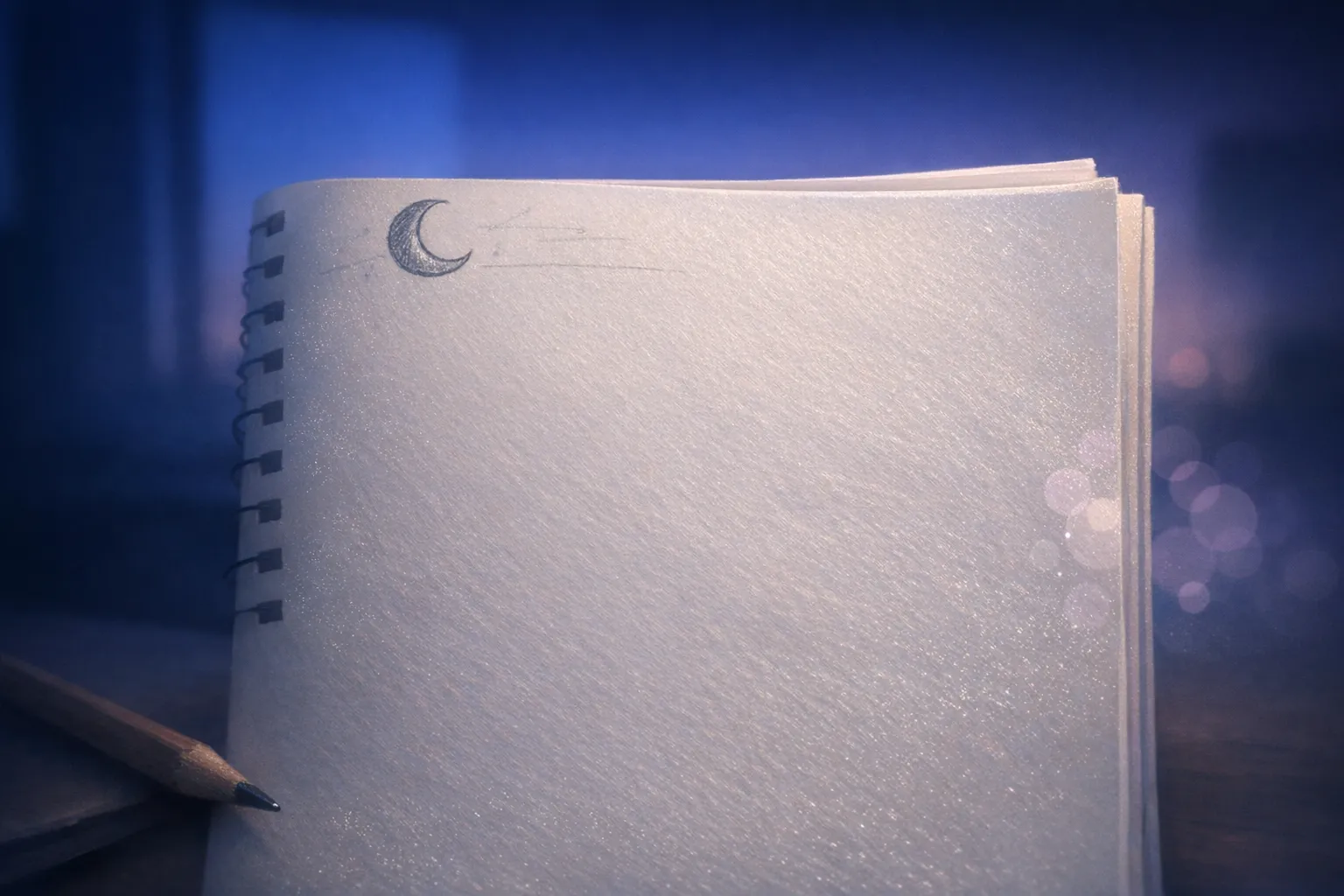
We love a big, cinematic omen, but it’s usually the small marks that tell the truth about our day. Picture this: you flip through an old notebook and there it is – a tiny crescent moon next to your messy lecture notes. Back then, it was nothing. Today, it’s a breadcrumb. You don’t need a grand theory to feel how that shape captured the hush of an evening you barely remember. Myth bust number one: a doodle doesn’t have to predict anything to be meaningful. Sometimes the point is not “future” but “this was your texture.” The sketch is a polaroid of your energy.
So if you’ve ever felt silly for circling a word five times and then shading it into a planet, same. I roll my eyes at me, too. And then I look again, and it’s like catching my reflection in a spoon – warped, funny, but me, unmistakably me.
The Cosmic Language of Doodles
Let’s start with the easy misunderstanding: no symbol is a one-size-fits-all stamp. A spiral isn’t “always anxiety,” a star isn’t “always hope.” They’re more like nouns with many adjectives you supply in the moment. Yet certain shapes tend to gather certain moods the way some friends always bring the best stories to a party.
Lines are willpower. Straight lines say “road,” “intention,” “don’t-distract-me.” When a page is full of long rails or boxy borders, I read focus with a side of control. But a waning crescent season often softens those rails into curves: a line that begins decisive and then drifts, like it remembered the ocean mid-sentence.
Circles are containment and cycles. Closed loops can be comfort – a little living room for your stray thoughts. Repeated circles can also be a gentle attempt to complete something you don’t want to leave open. Under the late-lunar hush, I often see circles incomplete, crescented, like we’re practicing letting things be “almost.”
Stars are bursts of attention, the brain’s glitter. Sharp, quick, radiating lines? That’s micro-clarity popping like corn. During the waning phase, stars sometimes shrink to tiny crosses or asterisks – footnotes to our main story, not fireworks.
Vines, waves, and tessellations are your psychic knitting. They appear when the mind is processing, not presenting. The waning time invites this inward weaving: scallops on the edge of a margin, tiny leaves along a line, lattices that look like fences but feel like hammocks.
And then there are eyes. Not spooky – just witnesses. An eye in the corner can be your inner observer peeking through the curtain. When the Moon thins, the eye often grows eyelashes or teardrops – embellishments that read like tenderness or release.
Here’s the myth-bust: doodles aren’t coded messages from a distant galaxy that only a mystic decoder ring can unlock. They’re closer to the hum you make while cooking. Still, hums have notes, and astrology gives us a playlist. In a waning crescent, expect subtraction art: erased lines, soft edges, edits, margins that feel like shoreline mist. Your pen doesn’t always announce the theme; it drifts into it. And if you want to experiment, gently notice what repeats across days. Repetition is how the diary turns into a dialect.
Exploring Doodled Symbols Under the Waning Moon
A waning crescent is the Moon in almost-vanish mode: last sliver before the lunar reboot. In plain terms, it’s the part of the cycle that favors exhalation. If the full Moon is a parade, the waning crescent is the cleanup crew with headphones on, humming. The psyche loosens its shoelaces. The hand holding the pen loosens, too.
Watch how your marks change in this window:
- Negative space grows. You may draw around things instead of through them – like sketching halos or leaving little islands of blank.
- Arrows curl back. Forward-pointing arrows sometimes morph into question marks or U-turns. Direction isn’t canceled; it’s reconsidered.
- Repetition becomes tiny. Instead of bold checkerboards, you get whispery hatches, stippling, ghost nets of lines you can barely see unless you tilt the page.
- Symbols thin. A full Moon doodle is a coin; a crescent is a fingernail of light skimming the edge of a thought.
Astro-lots – the old techniques of casting lots or pulling points from the chart like the Part of Fortune – offer a fun poetic layer here. You don’t need to calculate anything to borrow the attitude: these lots highlight where fortune, spirit, or eros hum in your personal map. Under a waning crescent, I borrow the gist of the Lot of Spirit: What direction is my inner wind moving, even if my sails look slack? When that question rides along, crescents on the page start to feel like commas rather than periods – a pause before a new sentence lands.
Misconception to retire: that you have to visualize perfectly to be “intuitive.” Mess counts. A smear of graphite can say “I’m done explaining” more honestly than a neatly outlined idea. If you find yourself shading the corner of a box darker and darker until the paper almost gives, that’s not you failing at art; that’s your psyche practicing eclipse.
And if you’re not sure whether a symbol means release or resistance, try the simplest experiment: draw it slower. If your hand relaxes as the curve closes, that’s release. If your jaw sets, that’s likely a boundary you’re fortifying. The moonlight in a waning crescent doesn’t judge; it’s too busy dissolving the leftover glitter from last week’s spectacle.
From Mindless Marks to Galactic Messages: A Doodle’s Journey
I know, the title sounds dramatic, but the journey is humble: attention, association, repetition, reflection. And because some of us like a trail to follow, here’s a short step-by-step that keeps the magic without turning it into homework.
-
Notice the climate. Before you even open your notebook, take a breath and clock the moon’s vibe. Is the crescent barely there? Imagine your page is twilight, not noon. You’re allowed to whisper.
-
Draw before deciding. Let five marks arrive without meaning. A line, a loop, a dot constellation, an accidental coffee ring, the shadow of your wrist. You are setting the alphabet, not writing the essay.
-
Name the feeling, not the symbol. Instead of “That’s a leaf,” try “That feels like relief” or “That feels like circling.” The waning crescent rewards verbs: softening, undoing, remembering, sifting.
-
Ask the repeating mark a friendly question. “What are you finishing?” for a row of ticks. “What are you saving?” for a pocket of white space. “What are you ready to stop carrying?” for a heavy, darkened corner. You’ll hear an answer not in words, but in the next line your hand chooses.
-
Cross-check with your day. If you’ve been pruning emails, you might see tiny scissor shapes or chevrons. If you’ve been daydreaming about travel, you may draw horizons or runways. Under the waning crescent, the cross-check often reveals endings disguised as beginnings: the doodle of a door may actually be about closing a window you forgot was open.
-
Return later. The meaning of a mark ripens like fruit on the counter. Flip back in a week. A crescent beside an old list might finally tell you which item belongs to “past-you” and can be released with a thank you.
Myth check: does every doodle equal destiny? No. Sometimes a spiral is because the pen skipped and your hand chased it. What transforms the mark is not cosmic certification – it's relationship. The more you visit your own visual habits, the more fluent you get in your private star map. You don’t need to be a great artist; you just have to be a regular witness.
And if you catch your brain scolding you – Stop scribbling, be productive – remember the waning crescent is productivity’s quiet twin. It files, it composts, it turns noise into mulch. Your doodles are the compost steam, proof that something is gently cooking down.
Astro-Lots in the Margins: Playing With Fortune, Spirit, and Eros
Let’s flirt with the idea of astro-lots the way street musicians riff on a melody. In traditional astrology, lots (sometimes called parts) are calculated points that poetically gather the themes of fortune (body and flow), spirit (will and aim), and eros (desire and attraction). You don’t need equations to let these three lenses color your doodle-reading, especially when the Moon is waning and everything is in subtraction mode.
-
Fortune lens: Which marks feel like the body taking a stretch? Thick, grounded lines that hug the bottom of the page, boxes that look like floor plans, sturdy dots like footprints. If these dominate, your margins might be telling you to tend the physical: sleep, soup, a slower walk. Under a waning crescent, fortune loves blankets. Your pages might look like quilts.
-
Spirit lens: Where do you see vectors – arrows, rays, paths? Spirit shows up as direction, even hesitant. If the arrows curl or fade, that’s not failure; that’s course correction. Picture a lighthouse dimming before sunrise, trusting ships to find their own way to shore. Your doodled paths can admit uncertainty without collapsing.
-
Eros lens: Look for ornament – leaves, stars with flair, eyes with lashes, letters that grow vines. Eros isn’t only romance; it’s magnetism. In a waning crescent, eros softens from pursuit to savoring. You may draw what you can’t quite let go of yet, not to clutch it, but to kiss it goodbye.
Now the myth-bust that will save you five spirals of guilt: doodles don’t have to be “high frequency.” Art-policing your own margins kills the point. If a page looks moody or swampy, congrats – you’re honest. The Moon’s thin lamp invites truth with the dimmer switch lowered. Some days the most spiritual thing your pen can do is scribble out a plan you never chose, like erasing chalk from a board after the bell.
If you want to anchor this in a tiny ritual, try this on the last three days before the new Moon: leave a quarter page blank on purpose. Label it “tide.” Throughout the day, add only what your hand reaches for without thinking. At night, glance back. Which lot spoke loudest? If Fortune, do one small body kindness. If Spirit, write a sentence to your future self. If Eros, place an object you love where you’ll see it in the morning. The margins become a tiny theater where your inner weather rehearses tomorrow’s sky.
And yes, sometimes you’ll accidentally draw a sandwich because you’re hungry. That’s Eros too, in the most literal, lovable way.
Reading Backwards: When Old Scribbles Start Talking
Here’s where the notebook becomes a time machine. You’re flipping, and suddenly past-you is waving with a little crescent moon doodle. Adjacent to it: a page of tidy notes about something you don’t even do anymore. This is the sweetness and the sting. The doodle is a breadcrumb from a self mid-metamorphosis, unaware of the wings about to grow or shed.
Retrospective reading under a waning crescent is especially tender. The sky is already mooded toward goodbye; your margins become the chorus. You’ll see:
- Crescents encircling due dates that didn’t matter in the end.
- Eyes next to names who drifted kindly out of orbit.
- Dense shading over projects that collapsed into compost for better seeds.
Myth-bust, crucial edition: finding these patterns doesn’t mean you “knew all along and ignored it.” We don’t fail ourselves by needing time. The point of reading backwards is to practice reverence, not regret. Those old marks show how your intuition hummed even when your calendar sang a different tune. Both were true. You navigated with the information you had.
If you want to invite a conversation with memory, ask the page three questions:
- What were you protecting?
- What were you practicing?
- What were you promising?
Protecting often shows up as borders and boxes. Practicing shows up as grids, scales, repeating forms – like fingering exercises on a piano. Promising sneaks in as stars, arrows, or a word circled and underlined. In the waning crescent’s soft lantern, you can honor these with tiny acts: retire an old to-do list like a ship’s flag, write a thank-you to a version of yourself who kept the light on.
And if something in you wants companionship for the translation – because sometimes the personal myth is louder when someone else listens – that’s what a good reader is for, someone who listens to your marks the way a musician hears the space between notes. If that tug persists, you might consider a psychic reading to bring your quiet images into dialogue with a wider, symbolic sky.
Ultimately, the margins don’t demand a verdict. They invite a posture: head tilted, heart softened, pen uncapped. The Moon slims down until it becomes almost nothing, and in that almost, we glimpse the everything we’ve been sketching toward. When the new light comes, it won’t erase what you drew. It will reveal the negative space for what it always was: a shape with its own bright edges, ready for your next, small line.

