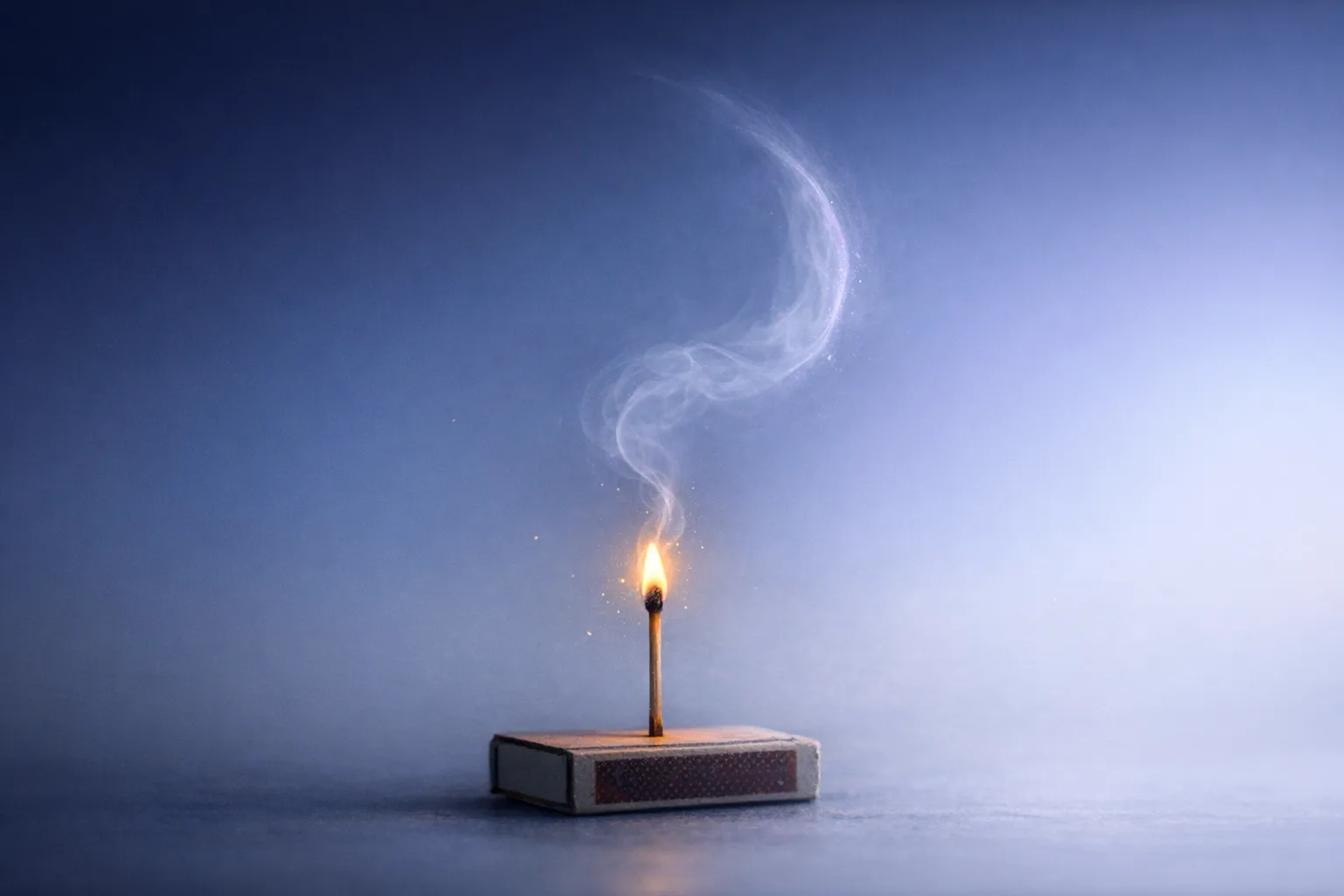
Letting Sparks Speak
You’ve held a match before without thinking twice – just a stick, a spark, a little help for the dark. Tonight, try again with different eyes. Myth says omens arrive like trumpets, but most of them show up in slippers. A match can be one of those soft arrivals, a message compact as a breath. As you strike it, you’re calling up a flickering moment where intuition is louder than logic but not at war with it – more like a dance partner keeping an unexpected rhythm.
I watch people expect grand signs: a meteor, a chorus of bells, a text with flawless timing. In truth, the universe often speaks in sidebar comments. The waning crescent – the moon’s sly wink before newness – sets the mood for small signals. This is the phase that loves whispers and adjustments, the tidy-up and tone-set before a fresh start. If you read tarot under that moon, you already know: a single card can hold a whole landscape. A single match can do the same. One flare, a curl of smoke, the way your skin registers heat or your ear catches a hiss – all of it is data, yes, but the kind that belongs to the heart as much as the head.
Let’s carve out a tiny theater for the act. The stage is a saucer or a fireproof dish, a window cracked or a balcony, and your honest curiosity. No big ceremony. No special incense necessary. You promise to notice, that’s it. People tell me, “If it’s real, it’ll be obvious.” I tell them: most honest things are shy at first. The flame is a miniature storyteller. It doesn’t hand you a conclusion; it nudges your attention to a place you’ve been avoiding or overlooking. If you want real clarity, meet subtlety halfway. Give the match thirty seconds, not prophecy-level pressure – just compassionate attention. You might be surprised how the smallest brightness names the thing you most needed to see.
Flicker Fortune: A Tiny Signal
Now to the strike. As you draw the match across the strip, take note of the first millisecond: the rasp, the bite of sulfur, the pop. In flame-reading folklore, that first flare is the ah-ha of the moment. If it leaps bright, quick, and then steadies, that can echo a clear start to something you’ve been overcomplicating – like that project you keep outlining instead of beginning. If it blooms boldly then retreats to a modest glow, you may be facing a burst of motivation that still needs pacing. And if it hesitates, sputters, and tries again, don’t label it “bad luck.” Maybe it’s a mirror for your own cautious hope – something that wants permission to try twice.
Temperature is a language too. Warmth gathering at your fingertips can suggest you’re closer to a decision than you think; the body registers commitment before the mind votes. A sudden prickle or discomfort might ask you to renegotiate boundaries. I’ve listened to dozens of people recount their match moments – an artist, a new parent, a recent graduate – and their stories rarely agree on the symbol-to-meaning dictionary. That’s the point. The match doesn’t hand down a universal verdict; it highlights your personal weather. If the flame pulls left, maybe your focus is drifting to the past; if it leans right, perhaps your attention is tipping toward tomorrow. Either way, you’re the compass.
Consider the short hiss as the flame finds its stride. In old sailor lore, a hiss means wind; in domestic lore, it means a quick change. I translate it as “breath is involved.” Where do you need to exhale? If the flame keeps licking at one spot, it’s like a teacher tapping the same place on the map. That’s the conversation starter. You can answer in the simplest way: nod, say “I see it,” and let the little light spend itself. Myth-busting note: the match is not a fate machine. It’s a prompt. It pulls a sentence fragment from your subconscious and hands it back to you, ash-dusted and sincere.
Smoke Signals: A Curl in the Night
When the flame dims and the smoke takes over, you’re reading in grayscale. Smoke-reading is playful – not because it’s trivial, but because it rewards imagination. You know how clouds become dragons when you’re in a generous mood and damp laundry when you’re not? Smoke behaves the same. Let your mood be an ally, but remember you can adjust it like a dial. If you see spirals, you might be tracking cycles: negotiations that revisit old points, dreams that ask for a second draft. If the smoke travels in a straight ribbon, think clarity trying to get your attention: a conversation that wants honesty without lace.
I’ve watched smoke curl into soft hooks, then open. Hooks suggest the mind trying to “catch” an answer – and the opening, a reminder to release the net. I’ve also seen smoke form little S-curves, the visual echo of a snake or a river. Snakes shed; rivers choose the easiest path while still arriving. Pick the metaphor that meets you where you live. I’m skeptical of one-size-fits-all omen charts. They flatten the wildcard. What if your straight ribbon means rails because you grew up loving trains? That’s the real traction. Your biography is the cipher.
Sometimes the smoke tumbles rather than streams. That tumbling can be delightful chaos – play energy, brainstorming without the harsh editor. But if the tumble makes your chest tight, it may be saying: your schedule is borrowing hours from your joy. Watch, too, for scent. That phantom, papery sweetness can recall letters, journals, or half-finished drafts; a scorched edge can hint at hurry. People ask, “Doesn’t this all sound like projection?” Absolutely – and that’s not a crime scene. Projection, when conscious, is a lens we can adjust. The smoke holds a moving mirror; you’re allowed to turn it to find the light that flatters truth. Think of it as your intuition doodling in the margins while your day does the heavy handwriting.
Myth-Busting the Mini Omen
Let’s set a few legends by the door and see which ones come back for dessert. First: “If the match goes out quickly, it’s bad luck.” No. A quick extinguish can reflect a boundary: something that isn’t meant to burn long. Imagine a text you shouldn’t send, a meeting that belongs in email form, a habit that was only ever supposed to be a trial run. The match taps the brakes; you’re still driving. Second myth: “Exact smoke shapes predict exact events.” That’s fortune-cookie thinking with a ruler. The shape is an invitation into your own metaphors. That personalized link is what gives the omen its heartbeat.
Third: “You need ritual tools and an elaborate setup.” Candles are lovely, altars are beautiful – but your nervous system and attention are the sacred gear. A clear intention like “Show me what I’m ignoring” can power the whole practice. Fourth: “Waning-crescent timing is a must.” It’s ideal for subtle insight because that lunar sliver is naturally introspective, a time for release and private edits. But if the only night you have is Wednesday with a raincloud, use Wednesday. The cosmos is not grading your stationery.
Last: “Omens are bossy.” Mini omens are more like friends who text you memes: timely, affectionate, occasionally roasting your avoidance. If the match does something startling or mundane, your job is interpretation, not obedience. I’ve stood under star-stacked skies and gotten nothing, then learned more from a stubby kitchen match in a dim corridor than from a thousand horoscopes. That’s not an anti-astrology stance; it’s a pro-context stance. Astrology provides weather; your match offers microclimate. The retrograde you keep blaming – retrograde just means a planet appears to move backward – doesn’t cancel your ability to choose. It colors the room. The spark hands you a portable lamp.
Interviewing the Flame: Composite Conversations
Over the years, I’ve held a kind of unofficial interview series with the flame. Consider this a stitched-together transcript from many nights and many hands.
I ask, “What do you do when people want a sign you can’t give?” The flame answers by flaring hard, then easing to a bead of light: “I show them a beginning that prefers gentleness to drama.” I ask, “What about panic?” The flame sputters once and regains itself: “Ask to slow down. Panic confuses heat with hurry.” I ask, “What if they demand yes/no?” The flame tilts to the window draft, then returns to center: “Show them the draft. Teach them to spot sway before they decide.”
There was the songwriter who struck a match after weeks of stuckness. It flashed bright and snapped short, sending a single gray ribbon to the ceiling. “Too fast?” she asked. The smoke kept climbing in one line. She wrote a chorus with only one long vowel holding it together – one line, rising. A barista I know asked whether to quit mid-semester to chase travel gigs. The match hissed like a kettle, then burned steady, low. He read it as “heat is there, but let it simmer.” He negotiated fewer shifts, saved, left in spring. His biggest omen wasn’t the hiss; it was the patience he found tracing it.
And there was the night I questioned my own intuition – the hazard of any reader. My match burned with a tiny blue heart at its base, steady as a held breath. I’d been racing to answers, and the blue said: oxygen, not speed. In color lore, blue flames mean hotter; in kitchen reality, they mean efficiency. Both tasted right. I didn’t get a prophecy. I got an adjustment: trust the small, consistent heat. This is the kind of conversation miniature omens excel at. They don’t map your life; they tune your instrument. Use tarot under the waning crescent if you like – pull a single card after the match goes out, and let card and smoke compare notes. The overlaps are startling in the gentlest way.
A Tiny Night Ritual for Real-Time Meaning
Here’s a compact, no-fuss sequence you can try when the house quiets and the moon is a sliver. Keep it simple; let the flicker do the heavy lifting.
- Name the question in one breath. Keep it small and specific: “What’s the next right nudge for my finances?” or “How do I ease the tension with my sister this week?”
- Ground your body. Place feet flat, shoulders soft, jaw unclenched. Feel the chair hold you. This is your anchor against anxious free-association.
- Strike one match. Observe the flare, the sound, the heat, and any lean of the flame. Don’t rush to interpret – collect sensations first.
- Watch the smoke. Note shape, direction, and how it moves or pauses. Mentally tag two words that arise – no poetry contest required: “spiral,” “steady,” “tumble,” “single line.”
- Pull a single tarot card, if that’s your language. Assign one of your two words to the card as a caption, and see how that word colors the image.
- Name one micro-action within 48 hours. Emphasis on micro: send an email, set a boundary in one sentence, move $10 to savings, schedule a conversation, delete an app for a week.
This is not spellcasting in the Hollywood sense. It’s maintenance of attention – sacred, sure, but also practical. If the match goes out in a blink, you still do the steps. If the smoke refuses to curl, you still name the words. Sometimes the most accurate omen is your reluctance to participate. That’s a message too: something in you is tired of asking big questions without making small moves.
In the final stretch, if you want extra perspective, consider a short psychic reading exactly as you’d consider a second opinion from a friend – someone to reflect your images back to you without stealing the steering wheel. The goal isn’t to outsource your knowing; it’s to cross-check your metaphors. When in doubt, return to the flicker. It is brief by design, but it leaves a lasting sketch. The match doesn’t promise permanence; it promises a nudge you can test. Tomorrow, when your coffee steams and the sky is undecided about clouds, notice something tiny and decide what it means. Then act as if you trust yourself for one day. The flame has already practiced.

