Moonlit Insights
Confession: I’ve always been the kind of person who lingers in the stacks a little too long, palms sliding over book spines as if they’re sleeping cats. Maybe you know the feeling – the hush, the dust motes doing slow ballet, the sense that something is waiting for you on a shelf you didn’t plan to visit. That’s how the waxing gibbous moon feels to me. It’s the almost-full kind of light, a breath before crescendo, the chapter right before the twist. In lunar terms, waxing gibbous is when the moon is growing brighter, rounding toward fullness; in human terms, it’s when our intuition swells and tiny intuitions bloom into sentences we can finally read.
Tonight’s metaphor: a library lamp. That pool of glow doesn’t illuminate the entire building, but it absolutely owns the circle it claims. The lamp doesn’t argue with the dark; it’s not in a hurry. It reveals just enough for you to keep going. During a waxing gibbous, we get that same “partial clarity” – enough to notice the dog-eared page, the underline in the margin, the question we keep asking. The lamp doesn’t shout. It whispers, “Look here.” And when we look, we find things we didn’t know were looking for us.
I like to think the moon is the world’s biggest reading light. It asks: What have you almost understood? What’s ripening? What deserves your trust if you’ll only lean a little closer? Right now, you might be one realization away from a paragraph that reframes the whole story. This is the time to let curiosity be your bookmark.
So consider this an invitation to wander. Pick up the books of your week – conversations you had, an idea that won’t stop tapping your shoulder, the way a certain song keeps replaying. Let the waxing glow be your guide as you skim, skim, then suddenly stop. Ah. There. That’s the sentence. Dog-ear the moment. You’ll want to come back.
The Whispering Lamp in the Library
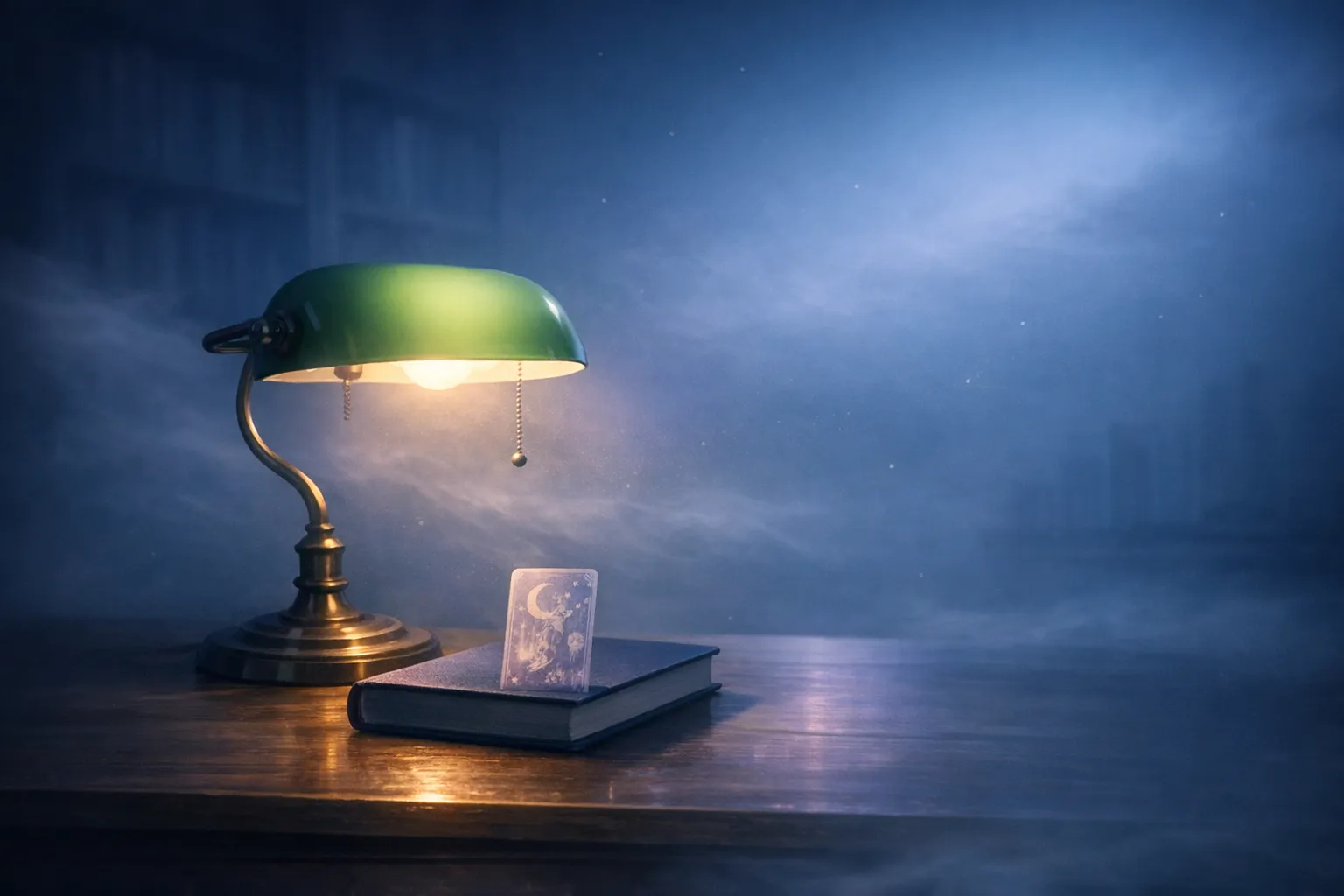
Picture yourself in a cozy corner of an old library, a green-shaded lamp humming quietly like it’s thinking in color. The table is wood-thick and etched with faint initials – proof that many seekers have paused here before you. Around you: a hushed sea of spines, old paper breathing its vanilla sigh. You angle the lamp a little, and the light becomes a private island on which only your questions are invited to land.
Now, something peculiar happens when you’re under that glow. It’s as if the books rearrange themselves in tiny, secret ways. Your hand drifts – first to a title you’d never choose, then to another that nudges your shoulder like a loyal friend. The lamp isn’t demanding; it’s suggestive. This is the mind-state of the waxing gibbous: certainty flirting with mystery. You don’t have the ending, but you can feel its gravity.
You pull down a book that feels heavier than it looks. When it opens, a forgotten note slides out. The paper is thin, slightly translucent, and the handwriting is old-school decisive. Maybe it says, “Ask her on Tuesday,” or “The map is not the territory,” or “Don’t ignore the yellow door.” The message isn’t your plot, but it’s your clue. That’s how the moon-lamp works. It doesn’t hand you a revelation; it coaxes your attention toward the one you already wrote for yourself in some previous chapter.
I find that if you sit still for two lamp-breaths (about as long as it takes to read a good stanza), the hunch you brought in becomes specific. The face gains a name. The problem narrows into a question. If you’re willing, answer out loud, even in a whisper. Sound anchors insight. The lamp loves it when you commit a sentence to air. It’s an old pact between light and language: if you give a thought your voice, it will give your voice a direction.
And just like that, the library stops being a building and becomes an oracle with shelves.
Bookmarking Auras with Tarot
If the library lamp is the moon’s way of circling a paragraph, tarot is the set of bookmarks we tuck in when the plot starts getting real. Tarot, at heart, is a picture-language: 78 cards, each one an archetype, a friendly symbol that says, “Here’s the energy you’re dancing with.” During the waxing gibbous, tarot reads like marginalia – bold, circled, starred. You don’t need to be a pro to get value. You just need to be willing to look at a picture and notice what tugs at your attention.
Try this: sit under your own “lamp” – any small light will do, especially if it gives your space a hush. Shuffle slowly, like you’re stirring tea. Draw three cards. Not for fate, not for doom, just for focus. Think of them as aura bookmarks: bright slips you place at the pages that matter. The first card marks what’s ripening – what’s nearly ready to be seen. The second tags what’s resisting – where there’s a crease or a knot. The third is the invitation – where to lean, what to say yes to.
Say you pull The High Priestess, the Eight of Pentacles, and the Six of Wands. The High Priestess is inner knowing – quiet water, closed-lip wisdom. The Eight of Pentacles is the practice bench: skill comes from devotion. The Six of Wands? Recognition, yes, but also the responsibility that comes with being seen. Together: your intuition is toning up through steady craft, and a moment of public proof is on the way. Your aura gets brighter where your work stays patient. Dog-ear that page.
Or maybe you draw the Moon, the Five of Cups, and the Star. The Moon card is dream-light and riddles; it’s the nighttime hallway that smells like rain. The Five of Cups says, “Yes, a spill happened.” The Star pours balm back into the scene, a gentle future pouring itself forward. Translation: feel the feeling, ask the question inside it, then aim for the soft-lit horizon. The waxing gibbous doesn’t promise closure. It promises clarity about what wants to close and what wants to open wider.
Your deck becomes a chorus of lamps. Each card, a different shade of green.
Turning Pages With Your Intuition
Let’s make this practical. If waxing gibbous is the library’s “almost” hour, you can nudge almost into action with ritual-meets-common-sense. Not everything has to be lofty. Some of the best divination acts like a good librarian: quiet, efficient, and fond of sticky notes.
Mini-ritual for glow omens:
- Choose your lamp. A desk light, a candle, even the dim of your phone screen turned way down. Claim a circle of attention.
- Set a time limit: 13 minutes. Enough to feel, not enough to dawdle into self-doubt.
- Ask one sentence. Keep it friendly: “What is trying to be seen right now?”
- Pull one tarot card or flip open a book and point. This is called bibliomancy, fancy word for “let the page surprise you.”
- Notice first impressions. Colors, numbers, a face’s direction, a single word. Don’t interpret yet; just collect.
- Speak one line into the room: “I’m willing to understand this.”
- End by marking something. A sticky note on your calendar, a digital reminder, a literal bookmark in a journal. Insight that’s not anchored will drift back into myth.
Here’s the secret art: letting your senses vote. The body has been reading symbols longer than the mind has. If the lamp’s warmth makes your shoulders drop, that’s guidance. If a card’s blue makes you ache for water, drink some and think while you sip. If a line in the book feels like a raised thread beneath your finger, pull gently. What unravels might be the knot you’ve been carrying in your pocket for weeks.
Remember that the waxing gibbous is a tide. Some nights you’ll feel fluent; other nights you’ll feel like you’re sounding out a new language. Both are progress. What matters is that you’re in the library of your life, showing up, turning pages, willing to find what you didn’t plan to seek.
The Quiet Interview: You, The Moon, And The Cards
I promised a playful exploration, so let’s turn this into a soft interview – a composite conversation between your intuition, the waxing moon, and your tarot deck. Imagine them perched at your library table, three patient beings sharing the lamp. You ask; they answer in symbols and hunches.
You: “What am I nearly ready to see?” Waxing Moon: “The outline is there. Try saying it without justifying it.” Tarot pulls: Page of Swords. A beginner’s mind with a sharp pencil. The page is honest to the point of awkwardness. The message? Draft the truth, then edit compassionately.
You: “What’s the forgotten note in my current chapter?” Waxing Moon: “The margin where you promised yourself rest.” Tarot pulls: Four of Swords. A nest of quiet. Permission to pause. Insight loves a rested narrator.
You: “What’s my green lamp asking me to highlight?” Waxing Moon: “The decision you keep treating like scenery.” Tarot pulls: Two of Wands. Vision on the balcony, globe in hand. Choose a direction; the map will draw itself once you step.
You: “Where can I place an aura bookmark so I don’t lose the thread?” Waxing Moon: “At the place where fear gets curious.” Tarot pulls: Strength. Not force – presence. Lion-heart with gentle hands. You are stronger when your tenderness leads.
A note on timing: the day or two before the Full Moon often delivers the nudge, the text, the small coincidence that rings the bell. That’s your confirmation ping. When it arrives, resist the urge to sprint. Walk to the next page. Read it out loud to yourself if you can. That’s how symbols become sentences, and sentences become plans.
If you feel wobbly, there’s no shame in asking for company. A conversation with a trusted friend, a journaling date, or even a brief psychic reading can help you translate your lamp-lit notes without losing their music. The key is to keep the tone curious, not punitive. This is discovery, not cross-examination.
In the end, the library metaphor reminds us: we are borrowers and authors at once. We inherit shelves of meanings, and then we scribble our additions. During the waxing gibbous, the lamp makes our scribbles legible. We see what we meant all along. We underline what matters. We slide a bright bookmark between pages and smile, because we know we’ll be back tomorrow, a little braver and a little more fluent in our own story.

