When Mercury Goes Retro
You feel it before you admit it: the faint hiccup in your calendar, the text that vanishes, the email that returns like a boomerang with an attitude. Mercury retrograde, the optical illusion where speedy Mercury appears to move backward, can scramble signals and reroute plans. But in that apparent backwardness lies a secret corridor – one lined with old memories, missed meanings, and the whispers in the wind that have been trying to reach you all along. Retrogrades don’t demolish your progress; they invite revision, a second gaze, a gentler listen.
Imagine the library’s hush at twilight. Fluorescents hum, a page turns somewhere, and you settle into that worn leather chair that’s molded to a dozen past readers. Your phone loses service in the stack’s concrete embrace. This is Mercury’s favorite mischief: removing the easy bridge so you can wander the long hallway. You notice your breathing fall into step with the building’s old pipes. The usual mental chatter untangles, and in that loosened braid something glimmers – an impulse to write, not from your plans but from a place that feels like a letter arriving from an earlier version of you.
When you lean into Mercury’s reverse waltz, you stop forcing the day to go in a straight line. You circle the subject. You let the question find a better question. That’s the terrain where automatic writing thrives. Instead of arguing with the retrograde, you collaborate with it. If communication is glitchy, maybe the message wants a more tender channel; if the map is smudged, perhaps your inner compass is brighter than you assumed. The trick is not to outthink the moment but to outlisten it. Place your attention on the quiet. Let the wind speak, even indoors.
So yes, the printer jams, but your pen doesn’t. Yes, the plan stutters, but your intuition clears its throat. Mercury in reverse is the librarian who switches off the overheads and guides you to a lamp-lit table, sliding a blank page across the wood with a look that says: try asking with your hand.
The Backward Dance of the Cosmic Messenger
Mercury, the cosmic messenger, is less a strict postman and more a swift-footed courier who loves shortcuts and riddles. During retrograde, that courier seems to walk backward down the hallway, peeking through doorways you forgot existed. Old conversations resurface; unmailed letters in your heart tug at your sleeve. This isn’t punishment – it’s choreography. The steps go like this: recall, revise, reframe. Retrograde is simply Mercury changing the rhythm, coaxing you out of default cadence into something more intimate, syncopated, and inner.
You might notice your thoughts turning toward half-finished projects, the poems you abandoned, the questions you filed under “later.” Under the soft sway of this cycle, you become a curator of echoes. The wind outside the library doesn’t howl; it murmurs. And if you listen carefully, the murmurs shape syllables. That’s where automatic writing sidles in – hand as antenna, page as shoreline, words rolling in like low-tide revelations. There’s no need to force profundity. The beauty of this dance is in its clumsy grace: you step on your own toes, laugh, then find the beat beneath the misstep.
To keep pace, lighten your grip. Hold the pen the way you’d hold a feather you don’t want to bruise. Let your sentences begin before you “know” them. Knowledge often drags a suitcase; intuition travels light. If a phrase tumbles out that seems odd – keep it. Retrograde messages often wear strange costumes. They make sense later, in the way old dreams ripen once daylight has warmed them. Think of the courier setting down a bundle with mismatched string and newspaper from a year ago. Inside: a memory, a warning, a grin.
You may worry about “getting it wrong,” but there’s no wrong in a dance that’s about discovery. The steps you invent mid-spin are the point. Mercury’s mischief is a kindness, pushing you past surface cleverness into the underlanguage you’ve been avoiding. In the backward drift, you face not the exit but the interior: corridors of phrase and feeling, stacks of unshelved instincts, a card catalog that suddenly clicks open with your name on it.
Messages from Beyond the Bookshelves
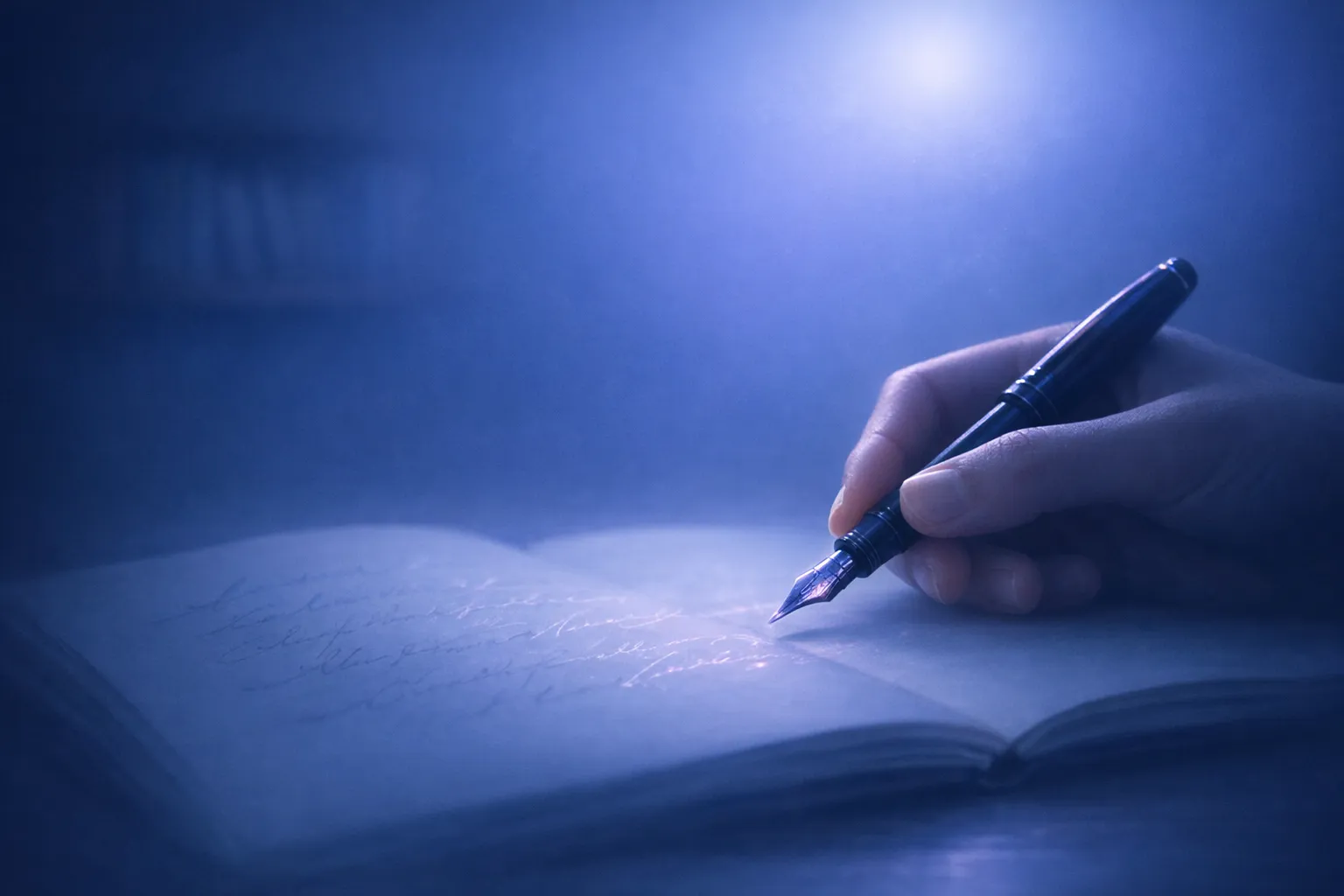
Now picture this: your favorite nook amid the tall, book-laden sentinels. You’ve tucked your phone away, and the table’s wood holds the faint scars of a thousand annotations. You rest a blank page beneath your palm and let your eyes blur. A gust at the door lifts the tiniest swirl of dust; it looks like a flock of commas. Somewhere, a dictionary sneezes shut. Then, without composing, without rehearsing, your hand begins to move. The first line is awkward – scribbles, loops, a half-word that looks like a bird’s footprint. But a current has slipped into your wrist. The words arrive like postcards with no return address: “Take the long aisle. Ask for the blue binder. Your voice is in the footnotes.”
Automatic writing is less spooky than it sounds; think of it as your conscious mind loosening its tie so the subconscious can sing a verse. You’re channeling, but not necessarily disembodied strangers. Often you’re receiving from deeper layers of your own psyche, where your experiences, hopes, and intuitive hunches braid into symbolic sentences. Sometimes the tone will feel familiar – your grandmother’s wit, your childhood logic, your future self clearing her throat. Other times the tone is archetypal, like the library itself is whispering: “Shelf seventeen, row three: remember your promise.”
You may get synchronicities – phrases that match a book title you spot as you look up, or a word you’ve been circling all week. Retrograde heightens that echo-chamber effect. It’s not trickery; it’s orchestration. The same way certain melodies find the same key, your inner voice finds external rhymes to nudge you along. A slip of paper falls from a novel. A stranger coughs on the exact word “begin.” You laugh, a little startled. The wind through the vestibule sounds like: write it down.
If you’re worried about fabrication, let the ink prove itself. Automatic writing ages well; reading it later under a different moon uncorks meaning. When Mercury stations direct again – the moment the planet shifts from reverse to forward motion – those pages often clarify into a map. What was cryptic becomes crisp. The postcard now has a date stamp. You see where you needed to circle back, where an apology waited, where a bold idea wanted a second chance. The library keeps its counsel, but it applauds quietly when you listen.
Mini-break: Myth vs. Reality
- Myth: Automatic writing means a ghost grabs your hand. Reality: Most of the time, it’s your intuitive mind emptying its pockets while your logical mind takes a coffee break. If something otherworldly joins in, you’ll still be the editor-in-chief.
- Myth: Mercury retrograde is a disaster zone. Reality: It’s a renovation phase. Walls move, echoes shift, and lost doorways appear. Yes, you might trip over a toolbox, but you’ll discover a room with better light.
- Myth: You must be “psychic” to do this. Reality: You already are, in the everyday sense of picking up moods, symbols, and patterns. Automatic writing simply amplifies a frequency you’ve been humming under your breath.
Postcards from Your Own Pen
Let’s get personal with a few mini-cases, like tiny rooms off the main reading hall, each with its own draft of wind and its own whispering shelves.
Case One: The Researcher You sit in the science periodicals, late afternoon. Your project has a stubborn hypothesis that won’t align. Out of exasperation, you place your palm flat on the page and write, without stopping, for five minutes. What arrives is a sentence about “method through memory,” and an image of an old family aquarium. You think, ridiculous. But days later, that metaphor unlocks a new experimental design: flow matters more than volume. You revise your method, and the data finally sings in tune.
Case Two: The Letter Writer You owe someone an apology, but your pride paces. During retrograde, you let your hand speak first. It writes: “Begin where you misheard.” You realize your wrong turn happened not at the argument but three conversations earlier when you assumed instead of asked. The automatic page becomes your rehearsal. When you finally speak, your tone is softer, and the apology lands where it should – on the soil where new trust can sprout.
Case Three: The Artist in the Reference Stacks You’ve been avoiding a canvas that scares you. In the library, tucked beside atlases, your scribble-session yields a list of colors you haven’t touched since childhood: pond green, popsicle orange, thundercloud violet. You laugh, then feel heat in your chest. The next morning, you paint with them, and a shape appears that looks like a doorway. You stand there longer than you planned, wind in your ears though the studio is closed tight. You call the piece: “Where the Echo Enters.”
Case Four: The Seeker Beside the Window You’re not sure what you want – a job shift, a home shift, or just a rhythm with less static. The page says: “Learn the small ritual of arrival.” You take it literally. For a week, every time you enter a room, you pause, breathe, and ask, “Why did I come here?” Decisions shrink to fit the present. By the end of retrograde, you discover the big move was never a city; it was the habit of showing up inside your own attention.
A short sequence, if you’d like a gentle practice to try:
- Choose a time when the library hush finds you – actual library or your living room’s quiet corner.
- Ground: place the soles of your feet on the floor, feel the chair hold you, notice your breath counting its own steps.
- Set a simple question, no more elaborate than a line from a postcard: “What wants my attention?” or “What am I ready to revise?”
- Write steadily for five to ten minutes. Don’t lift the pen. If you stall, write the stall: “I don’t know yet,” until the next stream arrives.
- Close gently. Date the page. Tuck it into a book that feels like kin. Let time hatch it.
In the final third of this retrograde, consider inviting outside perspective to braid with your inner notes. A single session – like a reflective conversation or even a brief psychic reading – can act as a margin note in the grand text you’re composing. Not to replace your intuition, but to harmonize with it, like two breezes finding one curtain and making it lift.
Remember: Mercury’s backward motion is a mirrored hallway where you see yourself from angles you’d usually miss. Automatic writing is how you catch those angles on paper before they evaporate. And the library? It’s not only a building. It’s the part of you that collects, catalogs, and keeps faith with your own evolving language. The bookshelves beyond the bookshelves. The hush that arrives when you’re finally listening.
When Mercury stations direct, keep the practice. The courier resumes forward strides, but the habit of the slow aisle remains. You’ll still find odd, helpful messages on the page, only now they carry your new return address. A phrase repeats: “Begin with arrival.” Another hums: “Ask again.” The wind outside shifts key, and for a moment, you hear your handwriting before you write it: a friendly ghost tapping the bell at the library desk, signing out a future you’re ready to read.

