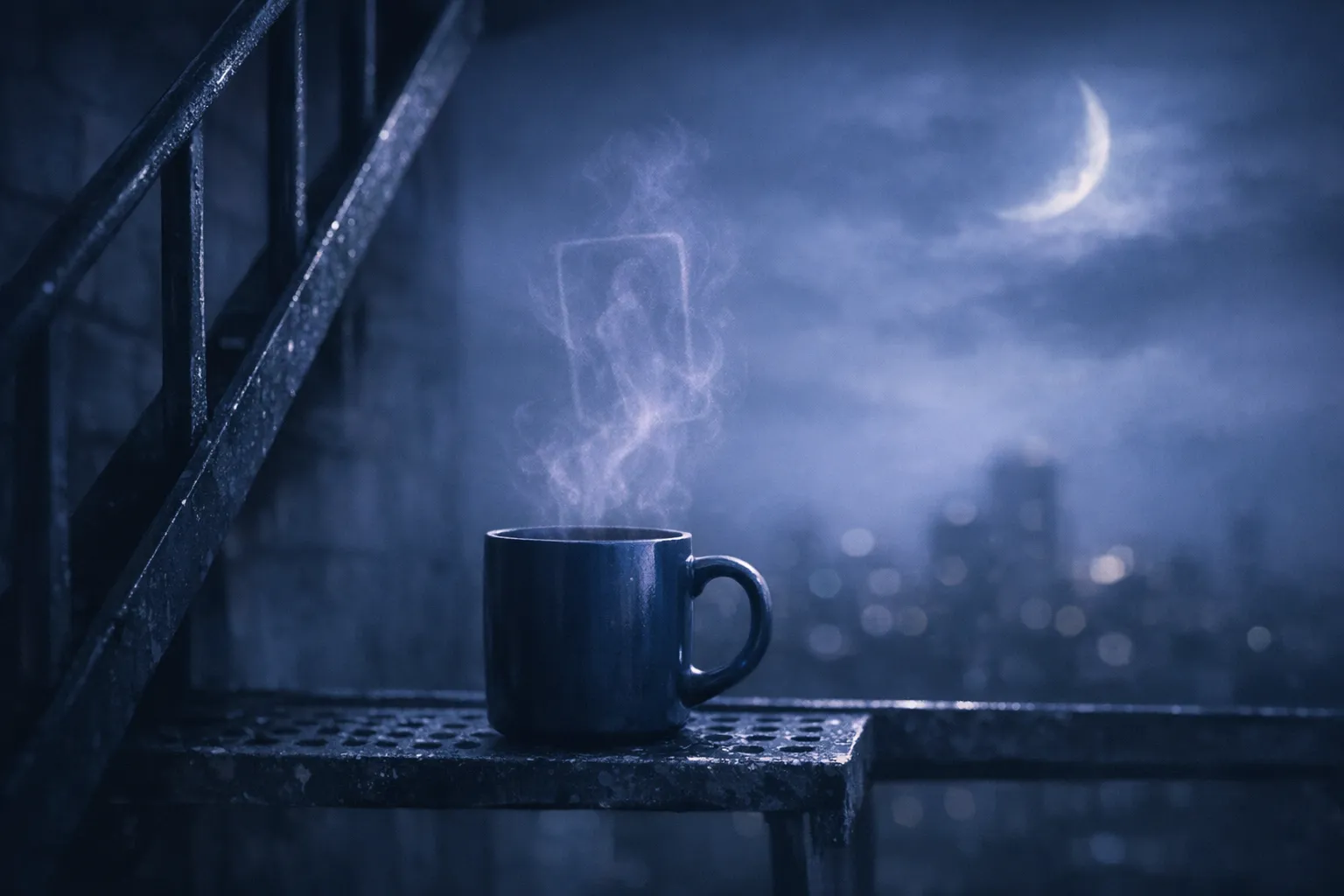
The Dance of Steam and Card
Picture yourself on a fire escape, sipping herbal tea as you sketch shapes in the steam that rises and dances in the chilly night breeze. The city’s breath moves through vents and alleyways; your own breath plumes in small, dragonish clouds. You’re somewhere liminal – outside but not quite outdoors, elevated but not removed. Liminal places are like hidden staircases: they connect levels of experience you don’t usually climb. Tonight’s staircase is formed of steam and a single tarot card.
Let me set the stage like a soft interview with the evening. I ask the night: What’s your thesis? The night replies, Keep it simple. I ask the steam: What do you know that I don’t? It says, I know how to vanish. I ask the card: Do we really need a whole spread? The card says, Not when one word is truer than a speech.
We carry stories about omens as if they’re stone tablets – hard, fixed, universal. But omens are more like sidewalk chalk. They speak while the surface is dry; they rewrite themselves in rain. Steam omens are famously slippery; tarot, too, can swim if you try to anchor it in an answer rather than a conversation. So here on the metal ribs of the fire escape, let’s unlearn the heavy myth that divination is a vending machine for certainty. I’m not here to sell prophecies. I’m here to notice: your hand on the mug, the flicker of a window two buildings over, the one-card invitation to ask a better question.
If you think the steam will cough up an instant destiny – job offer at dawn, soulmate on the D train – you’ll miss its real generosity. The generosity is in the noticing. Steam shows you how your attention behaves. Tarot shows you how your language behaves. The waning moon, overhead, behaves like a quiet librarian, pointing toward shelves you overlooked. Wisdom isn’t the thunderclap; it’s the hush that lets the thunder be heard. The card you pull tonight won’t fix your life. It’ll hold the door open while you step onto your own hidden staircase.
Reading the Tea’s Whisper
As steam curls around your mug, imagine its delicate language, forming fleeting shapes that mirror your inner thoughts. The old rumor says: if you see a ship, you’ll travel; a bird means news; a heart means love. Old rumors are charming, but they’re also hand-me-down sweaters – cozy, not always your size. Let’s try on the steam’s voice in your size. Ask a question – not for an answer, but for a direction. Something like, Where am I already moving without noticing? Then watch.
Steam doesn’t draw lines; it sketches suggestions. It frays and reforms like an idea revising itself mid-sentence. You might spot a doorway, or a staircase shape coiling upward (hello, motif), or a hollow ring like a portal. If you glimpse a doorway, ask: What room am I about to exit? If you glimpse a staircase, ask: Which step feels like reluctance, which like release? The shapes matter less than the feelings they tug. Steam is a mirror for the muscles of your intuition, not a set of standardized symbols.
Let’s challenge another myth while we’re at it: that you must be “born psychic” to read omens. No. You were born noticing. Psychic comes from psyche – soul, breath. If you’re breathing, you can practice. The steam lends its breath to yours. You don’t need to memorize a grimoire; you need to let your mind wander without scolding it. If your steam looks like a fox one second and a question mark the next, allow both. Paradox is the steam’s favorite punctuation.
Interview snippet, courtesy of the kettle: Q – Do you purposely make shapes? A – I make invitations. Your eyes RSVP. And from the mug: Q – Why do you cool so fast on the fire escape? A – Because truth likes the edge of things.
Hold your cup near your chest. Notice where the steam lands on your cheekbones, your nose, the back of your hand. The body is part of the reading. Warmth on the right side might feel like action; warmth on the left, reception. Trust your pattern. When the steam thins, that’s an omen, too: transitions often arrive as a little less of something before they become a lot more of something else.
The Cool Metal and the Ephemeral Dance
The cool metal of the fire escape anchors you while the steam invites you to find meaning in its ephemeral dance. The paradox is instructive: a staircase meant for emergencies becomes a sanctuary for minor revelations. It clanks and holds; the steam hums and disappears. Together they teach a tiny curriculum in presence and impermanence.
We’re told to treat omens as if they were billboards. Readable. High-contrast. Loud. Meanwhile, life is more like those narrow back stairwells no one photographs – scuffed, serviceable, undiscovered by tourists. The fire escape gives you the steadiness to perceive omens that don’t shout. Your hands feel the chill of the railing. Cold has a way of trimming the excess from questions. What did you come up here to know? Not the ten-year map. Just the next honest step.
There’s an everyday magic in this setting: the neighbor’s radio, the smell of someone’s garlic hitting a hot pan, the gossip of pigeons on the roof. Omens don’t mind sharing the stage. In fact, they prefer it. The smaller your theater, the truer your performance. If the steam reminds you of a sprinter’s start, maybe your body aches to begin something without ceremony. If it looks like a paper crane, perhaps your inner diplomat wants a gentler approach. If it shows you only a blur, you might be in a season of broad strokes – where detail will come later, like night vision acquiring depth after the lights go out.
Let’s bust a tidy superstition: that you must be perfectly calm to read anything intuitive. Please. Humans are weather. You can read as a thunderhead just fine. The trick isn’t to silence yourself; it’s to befriend your current climate. Put your restless foot on the cold rung. Hear the clang? That’s your punctuation mark – period, not ellipsis. Take a breath and try a single-sentence question. When we trim the question, the world trims the answer. The dance between the cool metal and the warm steam becomes choreography for the mind: ground, wonder, release, repeat.
The Waning Moon’s Gift
Under the waning moon, wisdom surfaces as clearer foresight and is the perfect guide for a one-card tarot pull. Waning simply means the moon is shrinking from full toward new, a visual exhale. Cultures have long used this phase for tidying, trimming, and honest appraisals. Not punishment – pruning. A plant doesn’t weep when you cut away what blocks the bloom. It reroutes its sugars and grows differently.
Why does a one-card pull glow under a waning sky? Because reduction is the mood. One card is a pressure test for excess: if your question is padded with shoulds, the card will show the seam where you can snip. During waxing times we add; during waning we refine. Think of the waning moon as a librarian switching off extra lamps, pointing to a single page. The myth to retire here: that more cards create more truth. Often, more cards just create more places for your mind to hide.
Here’s where skepticism deserves a chair at the table. Isn’t this all projection? Possibly. But projection is not the villain; it’s the highlighter. When you draw The Chariot and feel resistance, that’s your bias saying, I’m tired of pushing. The waning moon nods: then what can you release that makes motion lighter? When you pull the Four of Cups and feel oddly soothed, perhaps you’re ready to bless a quieter appetite. The card isn’t a decree; it’s a lens. Under a waning sky, we try on sharper prescriptions not to accuse our life but to read it.
Listen for the moon’s subtle cadence in ordinary choices: deleting a file you’ll never finish; washing a cup as if that were prayer; saying no without apology. If the steam sketches a staircase spiraling down, don’t assume descent is defeat. Cellars have jars of summer sealed for winter. Sometimes the step down is a vote for future sweetness. The waning moon hands you scissors, not shackles. Snip a thread. See what loosened garment you can move in.
Hidden Nuances in a One-Card Pull
Discover how the moon’s dimming light draws out the hidden nuances in tarot that remain elusive during other lunar phases. Not because the cosmos flips a switch, but because we do. Attention narrows. In a one-card pull, nuance is everything: shadow, border, posture, the odd detail you’ve skipped a hundred times. Tarot decks are museums you can carry; tonight you tour a single exhibit room with the world’s best docent: your noticing.
Let’s do a little interview-style composite. I asked three readers – an insomniac nurse, a bicycle courier, a college librarian – what a one-card pull under the waning moon gives them.
The nurse: “I read at 3 a.m. between beeps. One card is all I can meet honestly. If I get Strength, I ask how it’s different from endurance. Under the waning moon, I stop trying to be a lion about it and become the quiet hand on the lion.”
The courier: “I pull a card on my stoop after my last run. If it’s the Page of Pentacles, I notice where I’m learning responsibility instead of performing it. Waning makes me return the extra keys I never use.”
The librarian: “I turn a card near closing. The Hierophant used to annoy me, but in the waning phase, I see mentorship as compost – old knowledge breaking down into soil for new roots.”
Notice what changed for them: not the meaning, the willingness to thin the noise. Hidden nuance is often a softer verb. The Tower becomes editing. The Lovers becomes alignment. The Five of Wands becomes rehearsal instead of war. If you’ve treated tarot as a traffic cop – stop, go, turn – try greeting it as a stage manager whispering cues. The cue under a waning moon is almost always about subtraction that creates space for intention.
A quick myth-vs-reality break:
- Myth: Reversals are automatically bad. Reality: Upside-down can mean inner work, a delay with purpose, or an off-switch inviting rest.
- Myth: If you don’t feel a “spark,” the reading failed. Reality: Some readings are like tea cooling – drinkable once you stop trying to gulp steam.
- Myth: One card is too simple. Reality: Simplicity is a magnifying glass; complexity can be camouflage.
And if tonight your card confuses you, place it beside your mug, watch the steam pass over the image, and ask the simplest question: What can I release right now that I won’t miss tomorrow? Listen not for a sentence but for a loosening.
Threshold Ritual: Sip, See, Pull
We’ve debunked the billboard myth and let nuance lead. Now, at the threshold – between hot and cool, inside and outside – let’s blend steam and tarot into a tiny ceremony you can tuck into any evening. Think of it as three hidden stair steps. Each step is a gesture that teaches the next.
- Sip
- Boil water while naming what’s been overly loud in your head. Choose a tea that matches what you want to soften: peppermint for sharpness, chamomile for worry, ginger for stuckness.
- Step onto your version of a fire escape – balcony, stoop, open window. Feel the cool anchor. Place your feet as if greeting a staircase.
- Hold the mug. Take three slow sips. With each exhale, watch the steam’s first drafts of shape. Don’t translate yet. Just greet.
- See
- When a shape lands – a curve, a doorframe, a wing – let it link to a verb. Doors open, wings lift, curves hold. Ask: What’s my verb tonight?
- If nothing coalesces, that is a form. Name it “blur.” Ask: What blurs that I can lovingly sharpen?
- Set the mug down and notice where your body unwinds. That unwinding is the compass arrow.
- Pull
- Shuffle your deck with the verb in mind. On the waning moon, keep it subtractive: What can I set down to make this verb easier?
- Draw one card. Speak its first word out loud – no polishing. The raw word is the message before you negotiate with it.
- Pair card and steam: if you saw stairs and drew The Hermit, perhaps your step is inward study. If you saw a door and pulled The World, maybe your step is completion – closing what already fits.
- Thank the scene. Drink the rest while it’s still warm. Write one small release you’ll do before sleep: empty a tab, fold a shirt, unsend an apology to someone who doesn’t need it – send it to yourself instead.
In the final third of night, if questions linger like aftertaste, consider letting someone else hold the mirror for once – book a psychic reading or swap cards with a friend who knows how to listen without labeling. The point isn’t more information; it’s kinder focus.
As you go back inside, note the squeak of the window, the gentle bump of your hip on the sill. Liminal moments aren’t dramatic – they’re cumulative. Tonight you climbed a hidden staircase of steam, stepped down with a single card, and met a quieter floor of yourself. When the moon exhales, you get to exhale too. Set something down. Leave your hands open, not empty. The next step often appears exactly where the last one was – just a breath lower, or higher, depending on how the night wants to carry you.

