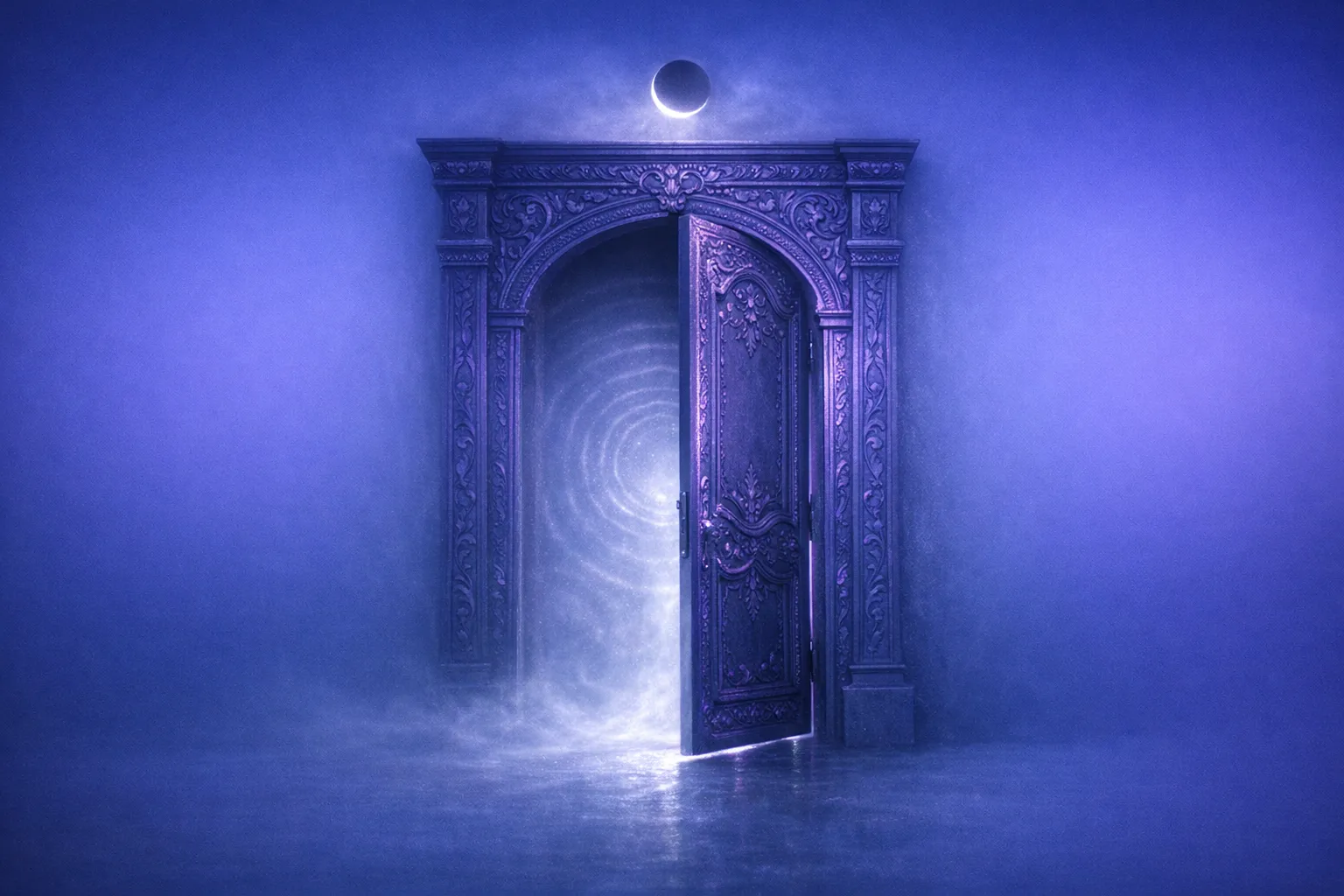
Unlocking Eclipse Enigmas
Here’s a curious thing: anthropologists once noted an uptick in recorded omens and dream-visions around historical eclipses – villagers, sailors, clerics all jotting down images like black suns, sealed gates, and beating drums in the sky. Whether or not those accounts were strictly accurate, the pattern mirrors what many of us feel today: eclipse season seems to tug our dreams into a theater of thresholds. There’s a hush, a held breath, the sense that the hallway lights dim so a door can reveal itself by silhouette alone. In astrological language, eclipses signal plot turns; not punishment, not prize, but edits to the script that move the story along. We don’t control the lunar lighting, but we do get front-row seats to the symbols that flicker through.
Imagine waking from a vivid dream of standing at a giant, ornate door, feeling the pulse of drumbeats echoing from the other side as an eclipse veils the moon. It’s a potent composite: the door as choice, the drum as momentum, the eclipse as curtain. Dreams love to condense meaning, and during an eclipse window – roughly a couple of weeks bookending the lunations – doorway imagery often crowds the stage. A doorway isn’t just an exit or entrance; it’s an agreement. Crossing says, “I’ll let this version of me end so another can begin.” That can be thrilling. It can also feel like a gulp.
Think of thresholds you’ve crossed: the first key to your new place, the last day in a job, the long exhale before telling the truth. We remember these because the psyche throws confetti and caution tape at once. Eclipses amplify that duality. In symbolic practice, this is when we treat images like guideposts rather than directives. If the hallway in your dream tilts, maybe you’re navigating a slant in expectations. If the door is locked, is it a boundary you need – or a story you assumed was final?
Tarot joins the chorus, not to predict a single fate but to offer a lexicon. Pull a card in the eclipse glow and you may find the deck nudging you toward a threshold you’ve already sensed. The cards won’t shove you through, but they’ll point out the knob, the hinges, the weatherstrip of fear, the lavender tucked in the jamb to calm you. When the sky edits itself, symbolic reading helps the heart annotate the edges.
The Dream of Doorways
During eclipse season, dream-life slips into architect mode. It drafts portals: cellar hatches, theater curtains, subway turnstiles, velvet ropes at museum wings you swore were closed. Doorways in dreams often flag transitions – marriageable ones, career-flavored ones, intimate ones that take place entirely within your own voice. If you’re hesitating at an elaborate door, the image may be staging a meeting between your longing and your doubt. Opulence implies value; your stall might mean you sense the cost of entry: honesty, change, practice. A door swinging inward can hint the shift is already yours, waiting for your arrival; swinging outward can suggest you’re invited to step beyond a comfort zone. Revolving doors can speak to cycles – repeated lessons that finally align for a cleaner exit.
Let’s translate a few dream motifs that like to visit under eclipsed skies:
- The knocking nobody answers: timing. Maybe you’re early. Maybe the “keeper” of this passage is resting. Knock again later with a kinder rhythm – or consider another entrance.
- Keys on a ribbon: authority. You own more access than you thought. The choice about which door to try matters less than the willingness to explore.
- A door underwater: pressure and grace. You can pass through, but breathing differently will be part of it – adjusting habits, pacing, expectations.
- Drums behind the door: the body’s tempo. Are you speed-walking through a chapter that asks for steady feet? The drum might be your heartbeat, amplifying what matters.
Eclipses cast high-contrast shadows on familiar rooms. The hallway may look uncanny, even if it’s just your apartment corridor in dream attire. That uncanniness doesn’t mean danger; it means significance. Symbolic timing hums beneath it. If lunar eclipses spotlight endings or culminations (the full-moon side of the family), solar eclipses hum with initiatory sparks (the new-moon cousins). But the psyche rarely labels the door “ending” or “beginning.” It hands you the handle and lets your grip teach you what you’re ready for.
One friendly rule of thumb: when a threshold dream feels cinematic – chiaroscuro lighting, slow-motion footfalls, a soundtrack of drums – assume your life wants a rite of passage, big or small. That rite might be as tangible as signing a lease or as interior as forgiving the part of you that hid. The dream isn’t commanding you to run; it’s nominating a moment. Your task is simply to witness the nomination, then trace where in waking life the hallway already exists. That’s where the omen lands.
Tarot's Eclipse Symphony
Tarot during eclipse season can sound like a drumline in a cathedral: ancient echoes, modern steps. Cards that already speak threshold – Death, The World, Judgment, The High Priestess, The Fool – often step forward. Not as doom-notes; as ushers. Death is the compost bin of the Major Arcana, not a horror story. The World is the diploma and the doorway back to curiosity. Judgment is the clarion that calls you to the stage you secretly rehearsed for. The High Priestess is the hush behind the door, intuition incarnate, keeper of footnotes you were meant to read. And The Fool says, “This threshold has no floor until your first step conjures it.”
If you pull The High Priestess during an eclipse, treat it like an inner librarian slipping you a sealed envelope. Hidden wisdom is key to crossing – perhaps journaling reveals the courage clause, or a conversation with your older self reframes the risk. Paired with the Two of Wands, the message might be to plan the crossing; with the Eight of Cups, to leave without slamming the door behind you; with the Ace of Pentacles, to plant a real-world stake: a budget, a calendar date, a class enrollment. Wands heat the drums; Cups soften them; Swords carve questions; Pentacles build the threshold into something your feet can trust.
A short step-by-step sequence for eclipse-aligned pulling:
- Name the door. In one sentence, describe the threshold you suspect: “I think the door is changing how I work,” or “The door is telling my truth to my sister.”
- Shuffle with the eclipse in mind. If it’s solar, ask what begins; if lunar, ask what completes or clarifies.
- Draw three cards: Guardian (what stands at the door), Key (what grants passage), Passage (how to walk through).
- Note one concrete action per card. Keep it small enough to finish in a week.
- Sleep on it and watch for dream echoes – colors, textures, a returning drum.
You can add a mini-ritual if your mood leans ceremonial: place a literal key on your deck, breathe until your heartbeat steadies, then cut the cards. Afterward, set the key on your windowsill during the eclipse hour you choose, as if offering it moonlight to learn your story.
The timing omen isn’t an ultimatum. It’s choreography. Threshold cards rarely insist “now or never.” They whisper “now or nearer.” The difference matters. When a reading and a dream both point to the same door, that’s your rhythm section. If fear pipes up, thank it for its vigilance – it’s a hallway guard, not your warden. Cross in daylight if it helps. Cross with a friend texting from the other side. Cross with reverence, not haste.
And if you want accompaniment beyond your own intuition, there’s no shame in asking for a guide. A single session can turn the echoing drums into a readable score, translating where you’re hesitating and why the handle sticks. At the right moment, a thoughtful psychic reading can braid your dream symbols and tarot pulls into a map with margins for wonder – spellbound footnotes included.

