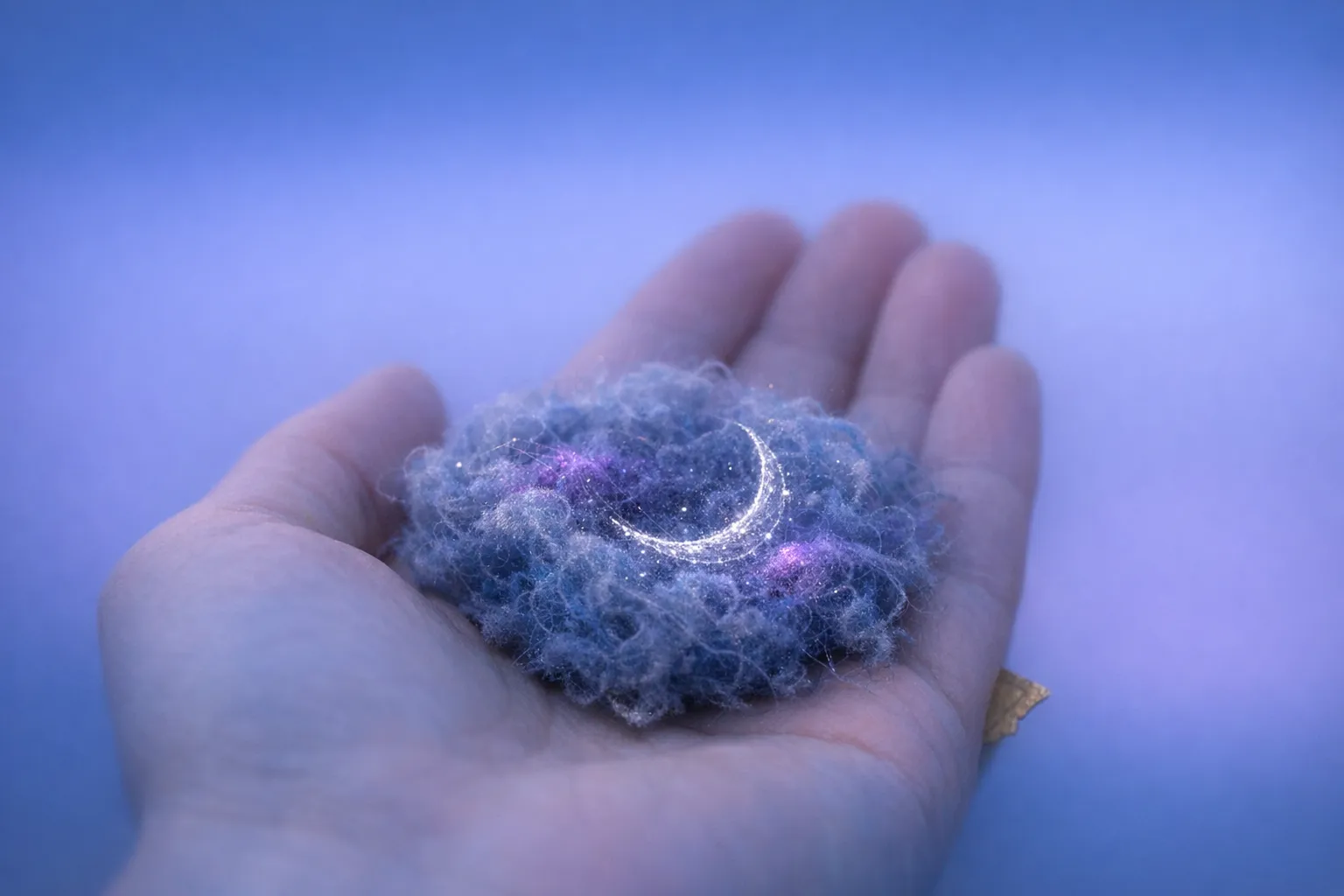
Unraveling Messages in the Mundane
Here’s a curious truth I keep circling like a moth: the human brain loves patterns, but the soul loves poetry. When I reach into a coat I haven’t worn since last season, I’m met not only by lint and a half-melted mint, but by a riddle written in domestic hieroglyphics. A button from nowhere; a paperclip; a single strand of thread that looks like a moonlit river. On their own, they’re clutter. Held at the angle of dream logic, they become mirrors – small, dull ones that still manage to throw back a glint of something secret and thoughtful.
Take pocket lint itself, that soft constellation of fibers. When I pinch it free, it’s as though I’m unspooling a memory that never had words. It reminds me of a recurring dream in which I sweep glittering dust from a tiled floor that has no room attached to it. The dream never offers a moral, but the symbolism hums: lint as residue of moments we thought were finished, persistently collecting until we choose to notice. In waking life, I can ignore it; in the dream, it refuses to be overlooked. And somewhere between the two, meaning finds a seam.
I once spoke with three acquaintances – let’s call them a musician, a librarian, and a florist – about the odd keepsakes their pockets deliver. The musician keeps finding crumpled set lists after nights they swore they would quit performing. The librarian discovers tiny torn corners from checkout slips whenever they contemplate a big move. The florist? A petal browned at the edges, exactly on days they’re unsure the arrangement they call “life” still looks fresh. None of them needed a prediction. They needed a mirror. The object doesn’t foretell; it reflects. Still, reflection changes posture. A person who recognizes themselves stands differently.
Finding a faded concert ticket stub could trigger memories of a dream where you sang on stage, signifying untapped potential. Dreams often speak in images distilled down to essentials: voice, stage, light, attention. A ticket stub is the receipt for permission – admission paid, entry granted. If you pull one from your pocket just as you’re telling yourself you’re “not ready,” that little rectangle may not be a prophecy, but it is an echo: once, you entered this door. Why not again? Lint, stubs, buttons – tiny postcards from the mirror-world, sent to the address of your attention.
Pocket Lint or Cosmic Clue?
A skeptic’s eyebrow rises here, and fairly so. Is this just apophenia – the brain drawing constellations between unrelated stars? Possibly. But constellations guide sailors not because the stars decide their fate, but because patterns steady the hand. The secret is in the framing. Treat the mundane as a dream fragment and it begins to speak in the only language it knows: suggestive, symbolic, evocative rather than prescriptive. I don’t ask, “What is this lint telling me to do?” I ask, “What does it remind me of, and why now?”
Consider the anchor example that drifted to me this morning like a bottle on a tide: Imagine finding a small, forgotten trinket in your pocket just as the moon begins to wane – reminding you of a dream you had about an old friend. If this were a dream, the trinket might represent a tiny but precious bond, an invitation to reconnect with an aspect of yourself housed in that friend. The waning moon – when the bright face thins and shadows lengthen – suggests releases, goodbyes, and gentle inventory. The “friend” in dreamwork often points to a quality you admired that you’ve misplaced. If the friend was bold with color and you’ve been wearing grayscale choices, the trinket flickers like a mirror: there you are, hiding in plain cloth.
In a casual composite conversation I had with several readers, one confessed to repeatedly finding loose screws. Another kept uncovering safety pins that had unlatched themselves. The third, a teacher, stumbled on pencil stubs grazing the lint like drifting oars. When I asked each, “What does this resemble in a dream?” the answers arrived soft and astonished. The screw became the missing piece to hold a plan together; the safety pin spoke of boundaries that had quietly popped; the pencil stub reminded them their voice could still mark the page, even if shorter than before. None of these objects bark orders. They simply catch the light at the right angle, and in that mirror-bright instant we recognize a pattern we already knew by feel.
Here’s the quiet trick: interrogate gently and stop before extraction turns to torture. Meaning arrives shyly. Hold the lint like a snowflake; name the first association that arrives; then set it down. Over-mining collapses the tunnel. A clue is most helpful when it keeps its smallness.
Waxing and Waning: The Moon’s Whisper to Us
Moons have moods, and we catch them like colds. During the waxing phase – the moon growing from a sliver to a platter – our attention naturally tilts toward gathering, building, beginning. The waning phase – the slow fade-out after fullness – asks for sifting, composting, and return. If retrograde is the sky’s “re” mode (review, revise, remember), waning is its soft exhale. When the moon is thinning, I find more “forgotten” objects resurfacing as if the house itself is tidying its memory. That’s less about magnetism and more about attunement. In waning time, we become better at noticing what we’ve carried too long.
As the moon wanes, notice how forgotten objects pop up, like the universe nudging you to let go. It’s not that the cosmos plants a paperclip; it’s that your inner janitor comes on shift and turns the flashlight toward corners. Another composite confidante – think of them as a patchwork of listeners from my inbox – tells me they always discover old transit cards right after the Full Moon. “I keep meaning to cancel that recurring pass,” they say. Perhaps the card is the mirror for outdated passages – ways of moving that cost more than they offer. Another writes of unearthing a seashell in a winter coat pocket. The image realigns the season: a waning moon can feel like tide going out, but it also reveals shells, glass, and keys long-buried beneath the foam.
Dream symbolism says the moon links to intuition, the inner weather. If you remember a dream during waning weeks, it’s often an editing pass, a quiet curator trimming the gallery to make room for next month’s exhibits. The objects you find then may amplify that theme. A receipt? Totals. A charm? Blessings you forgot you owned. A bobby pin? The capacity to hold something in place until a better design arrives. Invite the lunar rhythm to act as your index: what appears when we’re adding, and what appears when we’re subtracting?
If you want to play with this, try a simple one-breath check-in at dusk during the last quarter: What am I still carrying that has outlived its purpose? Then pocket that question and see what appears the next day. You might pull out a knot of thread: a tangle you’ve been smoothing socially. You might brush off glitter: a sparkle that belongs to a younger dream, still luminous but ready to be reassigned. The moon doesn’t command; it coaxes. We listen; that’s the exchange.
The Mirror Method: Reading Small Omens without Overheating
I don’t imagine cosmic command centers dispatching omens like mail carriers. I imagine a hall of mirrors, some grand and some cracked, all reflecting our posture back at us. The pocket is one such mirror – a velvet-lined stage where lint performs tiny ballets of exit and return. When I treat found objects as mirror-flashes rather than instructions, the results are more humane. Instead of “The universe says text your ex,” I hear, “You’re missing closeness, and here’s a symbol with your ex’s handwriting on it.” The action may be to call a friend, write a journal entry, or simply acknowledge the ache without recruiting an old story to carry it.
To keep the practice supple, I follow a brief, light-touch sequence. Think of it as setting a mirror at just the right tilt so the sunbeam lands where you need warmth without starting a fire.
- Notice: When an object appears, pause. Hold it like a sentence fragment.
- Name the first dream-image it evokes. Don’t edit. If the paperclip becomes a fishhook, let it.
- Place it on the lunar line. Are we waxing (gathering) or waning (releasing)? Let the phase color the interpretation, not control it.
- Choose a courtesy action. Courtesy means small, respectful, and reversible: a note, a breath, a five-minute tidy, a message to a friend saying, “Thinking of you.”
Courtesies prevent omen-overheating. They’re like cracking the window instead of tearing down the wall. One composite reader told me they kept finding duplicates of things – two pens, two nickels, two identical hair ties – just as the moon thinned. Their courtesy action was to pair up tasks that had lived apart. They merged two calendars. They combined two half-finished drafts. Meaning, mirrored, became motion; motion, gracious, stayed kind.
If you feel pulled to go deeper, the final third of a lunar cycle is a lovely time to schedule a reflective pause. You might journal a single page titled “What the pocket said,” or, if you crave a witness, invite a friend to trade symbols like trading cards. And yes, you could even book a psychic reading if a neutral mirror helps you catch the angle you keep missing. The point is not to outsource your wisdom but to hold it up to another surface so the shy parts step into view.
Mini-break: Myth vs. Reality
- Myth: A found object is a coded order from fate.
- Reality: It’s a mirror for whatever your attention is ripening to notice.
- Myth: The same symbol means the same thing for everyone.
- Reality: Symbols are bilingual: they speak culture and you. Your dialect matters most.
- Myth: If you miss a sign, you miss your chance.
- Reality: The world is generous. Another mirror will arrive, probably attached to your sock.
What I love about this practice is how soft it keeps me. I don’t have to chase meaning; I tidy a pocket and let meaning tap my shoulder if it wants to. The moon slides toward darkness and back to brightness, an ongoing rehearsal for vanishing and return. While it does, my coat grows lighter. I leave a trail of tiny offerings – a receipt here, a bent pin there – like breadcrumbs the future me will read with a smile, recognizing an old self waving from a mirror, pocket-sized, lint-lit, and quietly luminous.

