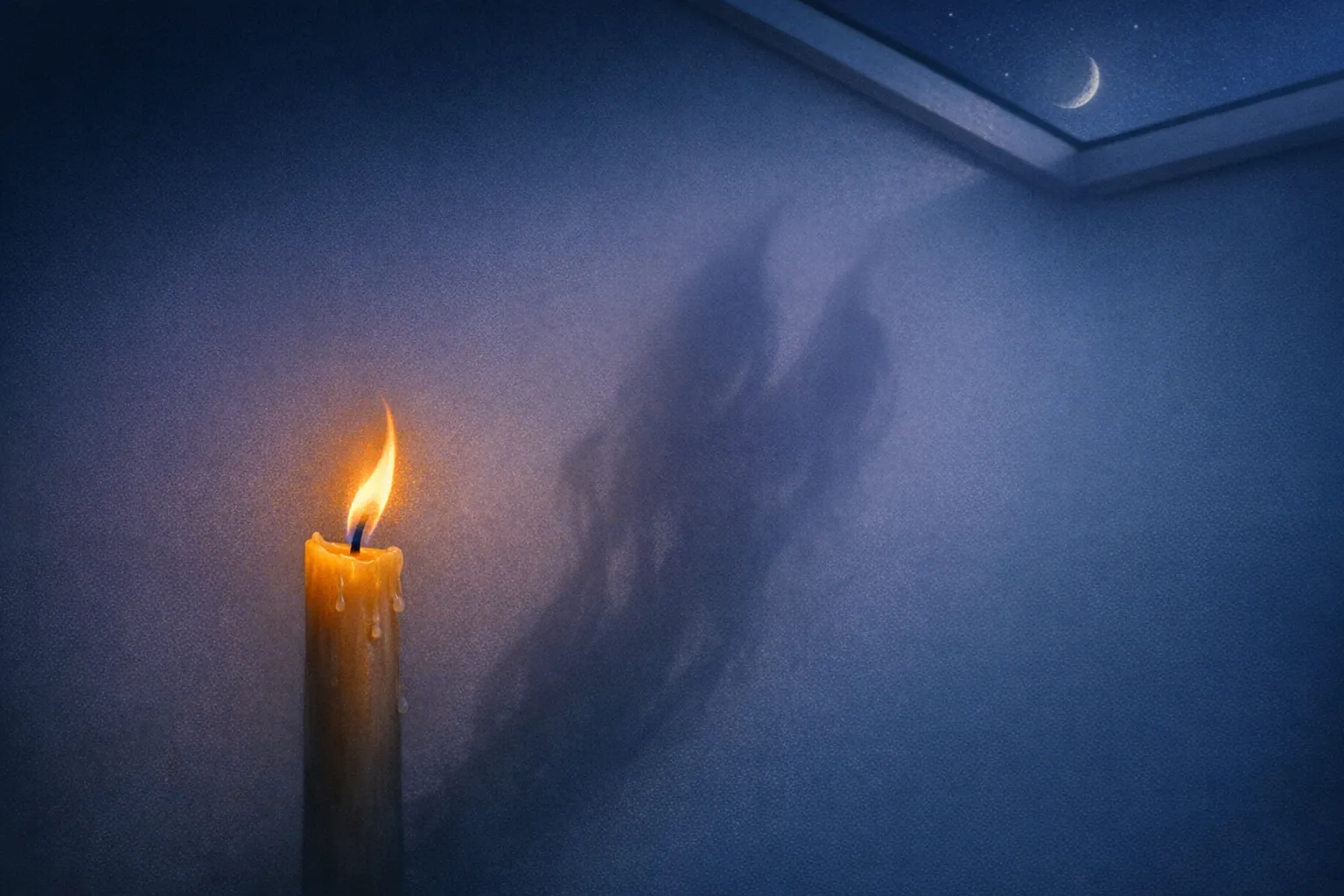
Swaying Shadows: A Dance of Messages
The most surprising fact I’ve learned from years of late-night scrying isn’t about the candle at all – it’s about the geometry of the moon. Quarter moons, whether waxing or waning, throw light with an edge. Half-lit, half-hidden, they sharpen contrast on everything they touch. When a candle burns under that split coin in the sky, its shadows arrive with definitions, like subtitles to a movie you didn’t know you were watching. I lean into that edge, placing a simple beeswax taper near a bowl or a wall and letting the flame sketch stories across the room. Shadows become my messengers: quick to appear, quick to vanish, and honest in a way bright daylight almost never is.
Imagine a night wrapped in stillness, a skylight open to the slow parade of the quarter moon. A single candle flickers on a table. The shadows twist and spin as if the wind were whispering in a language of commas and ellipses. When I listen with my eyes, I notice patterns: a swing to the left that feels like memory; a shiver to the right that hums like possibility; brief flare-ups that flash like exclamation points. I don’t treat any of it like lab notes. I treat it like poetry. The flame gives me metaphor, not measurement.
During quarter moons the room seems to choose sides. One wall brightens; another deepens; your attention flickers between them the way the heart wavers between what’s safe and what’s next. In that tension, insights surface. The psyche loves a stage, and the candle grants one – small, intimate, immediate. A flame might thin to a blue needle when a question turns precise, then bloom with yellow when the answer wants warmth. The trick is not to force it. Let your breath find a quiet, and let shadow-speech rise. What needs to be known often arrives not as a statement but as a silhouette, asking only that you trace its outline.
The Quarter Moon’s Enchanted Light
People sometimes ask why I prefer quarter moons for candle work when full moons get all the attention. Here’s my answer: the quarter moon is a hinge. It swings the month from one side to the other. Waxing quarters lean forward; waning quarters lean back. That tilt teaches me about thresholds – the moment a situation is more than it was and less than it will be. It’s also when contrast is cleanest. Half-bright moons don’t wash a room in silver; they edge it, giving candlelight room to choreograph. The flame becomes the lead dancer; the moon, the metronome.
In this half-lit theater, the psyche hears its own echoes. I’ve watched the flame take on distinct “moods” under quarter moons. During waxing quarters – when the moon is building light – the flame often feels aspirational, stretching taller, snapping brighter at questions about beginnings: a new collaboration, a study plan, a risk you keep almost taking. Its shadow stories show the scaffolding of a dream: you’ll notice clean stripes, steady pulses, symmetrical fans. It’s like the universe handing you blueprints for momentum. During waning quarters, the light is kinder, more retrospective. The flame curls low and gold, restful, the way a conversation grows softer after midnight. Shadows blur at the edges; oblong shapes drift into one another, telling truths about what to release, what to remember, what to forgive.
There’s a gentle superstition that quarter moons make omens speak plainly. I wouldn’t call it superstition so much as timing. When the sky itself is half in, half out, we are invited to read between lines. Candle scrying during these nights becomes a collaboration: the moon reduces the room to essentials, and the flame writes marginalia on the walls. Your job is to read the margins without insisting they be the main text. Trust your associations – first thoughts, stray images, odd bodily sensations. Symbolic light opens through symbolic sight.
Interpreting the Flicker and the Glow
A flame isn’t a weather vane, but it does have a vocabulary. The leftward lean, in my experience, speaks to the past or to the private room of your life – roots, intuition, what your ancestors would nod at. A pronounced left sway while you ask about a decision may hint that the answer rides on something already known or long buried. The rightward cant feels like the outer world – projects, invitations, public-facing choice. If, as you wonder about a job move, the flame pulls right and steadies, it often suggests the path wants your signature in the visible world.
Height tells a story too. A tall, steady flame murmurs, “You have fuel. Keep going.” A low, trembling wick might be urging patience, or better care for the container – are boundaries thin, is the room too drafty, are you asking too many questions in one breath? Quick rhythmic flickers can be like Morse code. I sometimes count them. Three fast flashes after a direct question often feel like a playful yes; a flash-flash-pause pattern can signal the need for nuance. If the flame gutters or smokes, I don’t panic. Smoke, to me, is the psyche exhaling what it can’t metabolize yet. Let the room clear, sip water, rephrase your curiosity more gently.
And then there’s trance. Sometimes, despite the left-right-left grammar, the flame becomes less about messages and more about transport. Your gaze softens, your breath falls into the candle’s rhythm, and thought releases its grip. In that timeless few minutes, answers aren’t read; they’re felt. You might see a distant coastline, or a grandmother’s shawl, or an image that makes no sense until tomorrow. That’s valid illumination. Intuition often hums rather than speaks.
If you like a little structure, try this brief sequence to frame your interpretations:
- Ask a single, open-hearted question – clear but not cramped.
- Watch for one minute without naming anything.
- Then note: left/right bias; height; rhythm; shadow shapes on the nearest surface.
- Close your eyes and catch the first image that drifts up. Write two sentences about it.
- Let it rest. Meaning matures like tea; don’t drink the leaves.
Voices from the Shadow Room
Over the years I’ve collected composite impressions from folks who practice quarter-moon candle scrying – snippets that read like interviews with the shadows themselves. One practitioner who paints at dawn told me the flame, during waxing quarters, clicks into a metronome when she’s ready to start a new series. “It won’t wobble,” she said. “My hand stops doubting.” Another, a gardener who saves seeds in jars, said that under waning quarters his candle always pulls left when he’s keeping too much. “It leans toward what can go back to the soil.”
A tarot reader I admire prefers a wide glass bowl as her screen. When she asks about collaborations, the shadow sometimes breaks into two tall forms that sway toward each other like partners bowing. If they overlap, she takes it as a sign the meld will be creative but tangled. If they keep a narrow seam of darkness between, she expects mutual respect and space to breathe. She doesn’t chase outcomes; she listens for tone. “Shadows don’t exaggerate,” she laughs. “They just show where the light can’t reach yet.”
Then there’s the musician who set his candle by a wrinkled curtain under a waning quarter and asked whether to quit a tour. The flame sputtered, smoked, and pressed low. He assumed it meant stop everything. But when he shifted the candle two inches, the smoke cleared, and the shadow stretched long and clean. He realized it wasn’t the music that needed pausing; it was the schedule. He cut two cities, kept his soul, and said the concerts felt like fireplaces instead of bonfires. The moral in all these tales is not that the candle knows your fate. It’s that focused attention – ritualized with a flame – lets your inner council speak a little louder. The quarter moon, with its elegant split, amplifies both/and truths. We become cartographers of nuance, mapping the negative space.
If you ever doubt your read, invite a second sense. Hum while you watch. Notice the room’s scent shift. Let your fingertips rest on the table and feel the micro-vibrations as the flame talks to the air. Insight often arrives through the side door.
Reading the Night: A Gentle Mini-Ritual
Here’s a quiet practice I return to during each quarter moon, to invite the shadows to speak without strain. It’s simple, portable, and kinder than grand ceremonies.
- Place a candle at the center of a cleared surface. Beeswax if you have it, because it burns steady and smells faintly of honey – reminding you the world is sweet even in mystery.
- Set a light-colored object beside it: a ceramic cup, a small bowl of water, or a folded cloth. This will catch the shadows in soft relief.
- Open a window or skylight if the night allows. Let the quarter moon be a silent witness.
- Write one question on a slip of paper. Avoid binary traps; choose something like, “What wants my care next?” or “How can I move with grace through this change?”
- Light the candle. As the flame rises, imagine a door in your chest unclicking. Breathe in four counts, out six. Longer exhale, longer listening.
- For three minutes, watch without interpreting. Let your mind be the lake; let the light throw pebbles.
- When your curiosity begins to reach for meaning, invite it to sit back. Now, gently observe: Does the flame bend left or right? Grow tall or tuck low? Do shadows ripple like water, or stack like books? Does the glow spark an image, a word, a bodily yes/no?
- Close with gratitude, even if you feel uncertain. Extinguish by snuffing rather than blowing, to honor the conversation you just had.
During the final third of the month – waning quarter – the ritual excels at release readings. Ask what to lay down. During the waxing quarter, let it feed beginnings. And if you find yourself tangled or curious for companionship in the symbol-weaving, you might schedule a psychic reading with someone who can mirror your impressions and offer fresh language for what wants to be known. But remember: you are already conversant in shadow-speech. The candle simply reminds you to listen in silhouettes.
When I finish a session, I like to sit in the residue of the glow, the way you linger in a doorway after a good conversation. The room feels cleaner, edges kinder, and my choices quietly re-arrange themselves, not like marching orders but like constellations finally visible between clouds. The surprise remains what it was at the start: the moon’s geometry makes edges, and edges make messages. Leave the night a little darker than day and the truth will draw itself, one flicker at a time.

