Stargazing From the Griddle
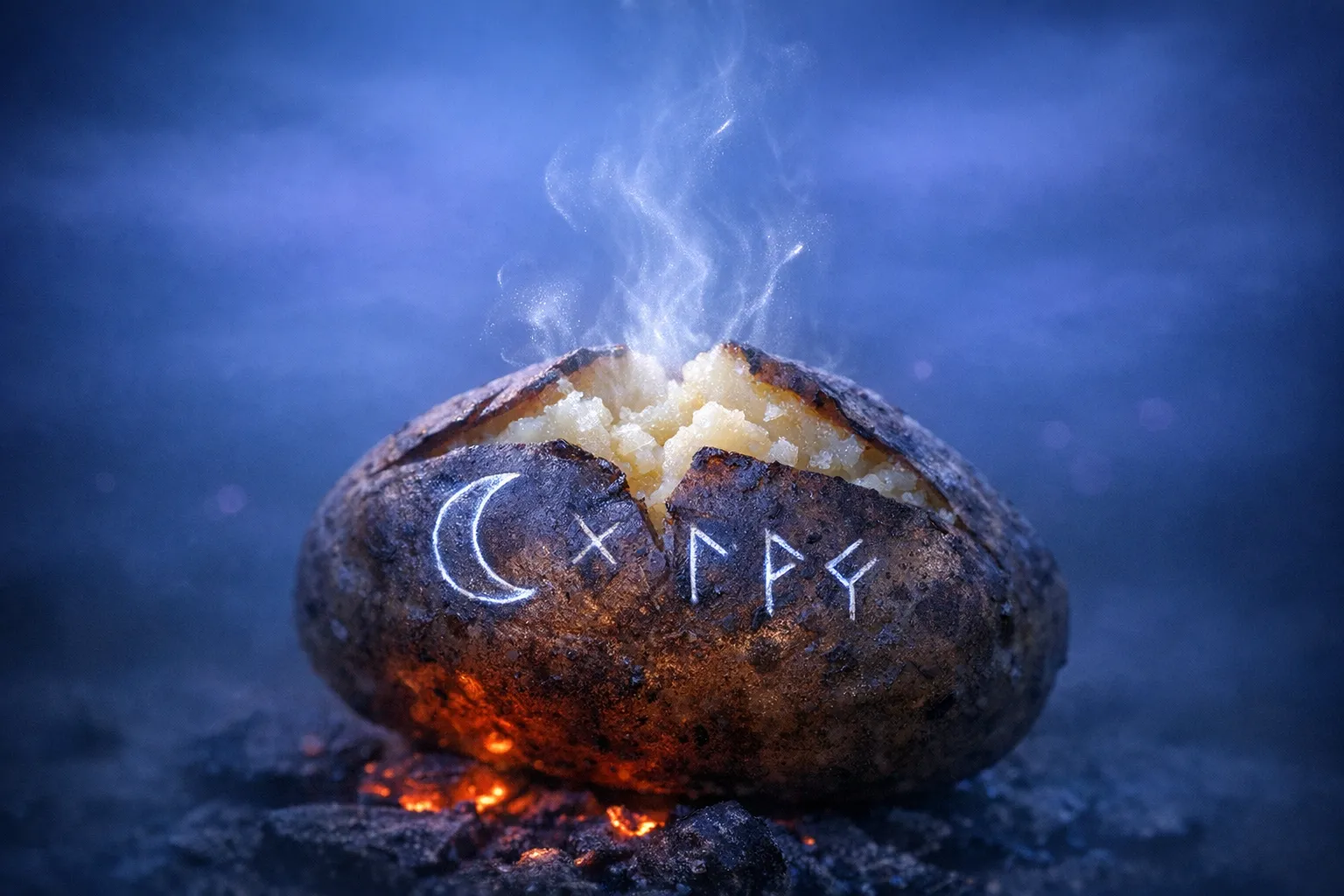
You arrange the potatoes like small moons around the heat, and the night leans in to listen. The waning crescent hangs like a quiet smile, a phase of release and soft edits – perfect for recipes that welcome imperfection and wisdom. You score the skins with the tip of your pocketknife, tiny constellations mapped in brown and gold, as if flavor could be navigated like a sky chart. Every sizzle sounds like a whispered star name. The smoke is cedar-gray and patient. You could call this simple cooking, but it feels more like a translation exercise: the fire speaks in crackles, and you answer with buttered offerings.
Rune-work begins small. You carve Algiz (protection) as an antlered fork, or Sowilo (sun) as a sharp S that promises brightness even under moonlight. Runes are old symbols said to carry archetypal currents – think of them as poetic shortcuts to energies we all sense but rarely name. You press a pinch of salt where each line crosses, like stardust smashed into stone. The potato absorbs it steadily, as humble as earth, as generous as a field after rain.
The celestial dance of flavors starts its turn. Rosemary becomes a comet tail, smoke a velvet nebula, butter a quiet sunrise melting over hills. You watch the skins blister and lift, listening for soft pops that sound suspiciously like answers. This is a waning moon trick: you season what you want to keep and give to the flames what you’re ready to outgrow. The potato is a talisman you can eat, a grounded blessing; every crisped edge is a page cornered in the book of tonight.
You lean back. The embers shift and your breath rises in pale ribbons. Around you, friendships settle into their constellations – loose, bright, imperfect, true. The first potato splits. Steam curls up in runic script you pretend to read before it vanishes. You realize the recipe is not only in your hands. It is above you, and below you, and now, warming your palms.
Runes in the Peel, Stars in the Steam
Hold a potato and let it choose you back. Its weight is low-gravity comfort, starchy and earnest. With the moon thinning in the sky – a waning crescent, that inward-breath phase that favors trimming, cleaning, releasing – your knife makes lines that carry intent the way rivers carry moonlight. If you’re newer to runes, pick three you can draw without squinting at a chart: Fehu (the cattle rune, a sign of resources), Kenaz (a torch, for insight), and Raido (a journey, for momentum). Don’t fret about perfect angles. The universe forgives wobbly handwriting; sincerity seasons better than precision.
You rub olive oil into the marks so they gleam like wet constellations after a rain. The oil gives the runes a runway; the heat will do the rest. You sprinkle salt like first snow and crack pepper like new stars appearing. The rhythm of this season – light fade, embers glow – coaches the palate towards subtlety: thyme that lingers, garlic that murmurs, a squeeze of lemon added late like a sliver of moonlight across a black lake.
When the foil packet puffs, you open it to a galaxy of steam. Watch how it curls. If it snakes sideways and vanishes quick, you might be due a detour – Raido laughing from the peel. If it rises clean and straight, Kenaz is on duty, clearing the path with a lantern’s calm. If it blooms, hangs, then thins to nothing, Fehu suggests an ebb before the next tide of abundance. None of this is proof; it’s permission to notice. Divination, like taste, depends on nuance.
You set the cooked halves face-up, runes darkened and dignified. Butter goes in like a comet strike – instant crater, golden spill. You taste. The starch holds the wisdom the way loam holds rain: temporarily, thoroughly, generously. If you hear an old doubt surface in the mind’s simmer, exhale. The waning crescent is excellent at composting what you’ve outlived. Every sigh feeds the coals.
The Celestial Dance of Flavors
Think choreography, not chemistry. Let the ingredients waltz to the rhythm of the fire. Potatoes are the steady bass – earth’s heartbeat, patient and grounding. Butter is the saxophone, suave and a touch decadent. Smoke is the backstage fog machine that makes everyone look more mysterious than they actually are. And the herbs? They’re the quick-footed stars: rosemary’s needle-light leaps, thyme’s soft taps, dill’s whimsical twirls.
Before the heat takes over, whisper to each rune in turn. Fehu, dusted with smoked paprika, brings a campfire sun into the center of your tongue; Kenaz loves a shard of garlic crisped to gold; Raido’s road is paved with lemon zest, bright as a reflector at midnight. Sizzle is applause. Don’t crowd the pan or the packet; even stars need space. Rotate the potatoes like planets so each side gets its moment in the heliograph of coals. The scents braid together – sweet starch, mineral salt, resinous green – like the night braids breeze with memory.
If someone asks for a recipe, smile and hand them a potato. The dance lives in practice, not paragraphs. Feel for doneness with a gentle squeeze: give, then spring back. That’s the moon’s signature, that soft give of endings softening into beginnings. A waning crescent doesn’t demand; it suggests. It doesn’t shout; it hums. So you hum with it. You let the edges catch a touch of char – the way some stories must get singed to be interesting.
When you plate, imagine constellations: three potatoes for Orion’s belt, a scattering of parsley for distant galaxies, a final lick of olive oil like Milky Way light spilled from a slender jar. Eat slowly. Notice how the first bite says “arrival,” the second says “remember,” and the third quietly says “release.” On nights like this, your tongue is a small oracle and the campsite is a theater where wisdom arrives in buttered boots.
Reading the Cracks, Reading Yourself
When the skins split, they don’t just announce doneness – they sketch a map. You look for stories in the fractures the way you look for figures in clouds. A long, single seam running straight across? There’s a path you already know; keep walking it, but lighter. A spiderweb of tiny cracks? Many possibilities, all asking for less pressure. Deep burst at a corner with char dark as midnight? That’s a pocket of heat where you overcommitted – time to redistribute energy with kindness, not scolding.
Crack-reading is a cousin of palmistry: less hand, more spud, same curiosity. It’s symbolic, not scientific, and yet your belly knows what it knows. Under a waning crescent, you’re reading for what to unthread. The moon is the editor with a soft pencil; you’re the author tasting your own revision notes. If a potato opens in a shape that reminds you of a letter or a rune, let that letter stand for a word you need tonight. M for mercy, R for rest, S for saying no without footnotes.
You may notice the potatoes that held extra moisture collapse into tender caves. That’s not failure; it’s the art of surrender, starch accepting steam’s love letter. If you’ve been carrying steam under the skin – thoughts you never plate – let the hiss counsel you: pierce earlier next time. In food, as in feelings, vents are friendships.
For a moment, the campfire’s circle tightens. Someone snorts at a joke; someone else watches Saturn nod toward the trees. You pass a tin of flaky salt with the exaggerated care reserved for small, sacred objects. In a world of dashboards and deadlines, it’s disarming to let a potato read your mood. Yet here it is, cracking open with the grace of a confession you were brave enough to make. Eat. Forgive. Offer the crisped bit you’d usually claim to the person next to you. The rune for generosity tastes like that.
A Waning Crescent Mini-Ritual for Flavor and Letting Go
The moon is a slim boat tonight, ferrying what you’re finished with across a dark river. You don’t need robes or rare herbs – only potatoes, a pocketknife, salt, and your breath. This is a small rite stitched into a meal, easy to tuck under the stars.
- Carve: Score one simple rune into each potato – Fehu, Kenaz, or Raido. As you cut, name one small thing you’re ready to release: an overfull schedule, an unkind thought you keep rerunning, a perfection you can’t afford anymore.
- Salt: Sprinkle with intention. Think of salt as crystalline moonlight – clarity that doesn’t scold, it seasons.
- Fire: Place the potatoes near heat, not directly in the inferno. Let them warm in the liminal edge where change happens without drama.
- Watch: When the skins begin to lift, exhale slowly. That’s the old pattern uncurling.
- Share: When you eat, trade halves with someone. Let your rune become theirs and theirs become yours – mutual metamorphosis in a single bite.
You’ve performed what the night understands: exchange, easing, trust. Under a waning crescent, ritual is less summon and more soften. The energy turns inward like tide drawing back to reveal small treasures in wet sand. It’s a good phase for goodbyes that don’t slam doors. The potatoes teach patience; starch takes time to sweeten, and not every moment needs flame at full tilt. The celestial dance of flavors is gentler than a parade. It’s a slow orbit around contentment.
If you want deeper symbolism, add a wedge of lemon at the end – the moon’s cousin in your hand, sharpening the story without stealing warmth. You taste brightness and let go of bravado. You notice how easy it is to say “enough” when your mouth is full of something kind. Even the embers agree, pulsing like a heartbeat under ash.
Afterglow Oracles and Tomorrow’s Leftovers
The fire settles into red punctuation marks. Your pan is dotted with crisp bits you could map like small archipelagos. Tomorrow’s breakfast is already a promise: leftover runed potatoes smashed into a new constellation with eggs, or folded into a midday salad that remembers campfire smoke the way a coat remembers winter. The messages linger, too – quiet phrases the night left in your pockets.
On your way to sleep, listen for the soft commentary of the waning crescent: pare back, keep what feeds you, compost the rest. If your mind wants a sign, let it be practical. The potato that refused to cook evenly? Where are you heating some things and ignoring others. The packet that steamed perfectly because you rotated it? What would benefit from a gentle turn, not a dramatic leap. Divination doesn’t always ask for incense; sometimes it asks for a spatula and five more patient minutes.
If you’re curious to stretch this practice, you might journal the rune you carved and how the potato opened, then check in a day later to see what mirrored it. Treat the record like a sketchbook – charcoal smudges and all. The sky is different every night, and so is the appetite. When friends return to your fire, invite them to choose their own sigils. Some may pick runes, others a star’s initials, or even a doodled spiral for “keep going.” Synchronicity is hospitable; it meets people where their forks already are.
And if one evening, under a similar slice of moon, you feel called to ask bigger questions, there’s room by the flames for that, too. Some nights the steam rises with a shape you’ve seen before, and your chest answers with a yes you didn’t know you’d stored. That’s when an outside mirror can help you hear your inside echo; a thoughtful psychic reading can be that mirror, translating the same symbols you taste tonight into language you can take home.
For now, though, scrape the pan, lick a finger, and thank the potatoes for their sturdy diplomacy between stomach and soul. The embers fade like notes held just long enough. You stack the plates and tuck the knife away, moonlight glancing off its back as if to say: see you at the next orbit, the next recipe, the next small ceremony you’ll disguise as dinner. Under stars, the ordinary keeps slipping its mask and grinning. It tastes like butter and smoke. It tastes like staying.

