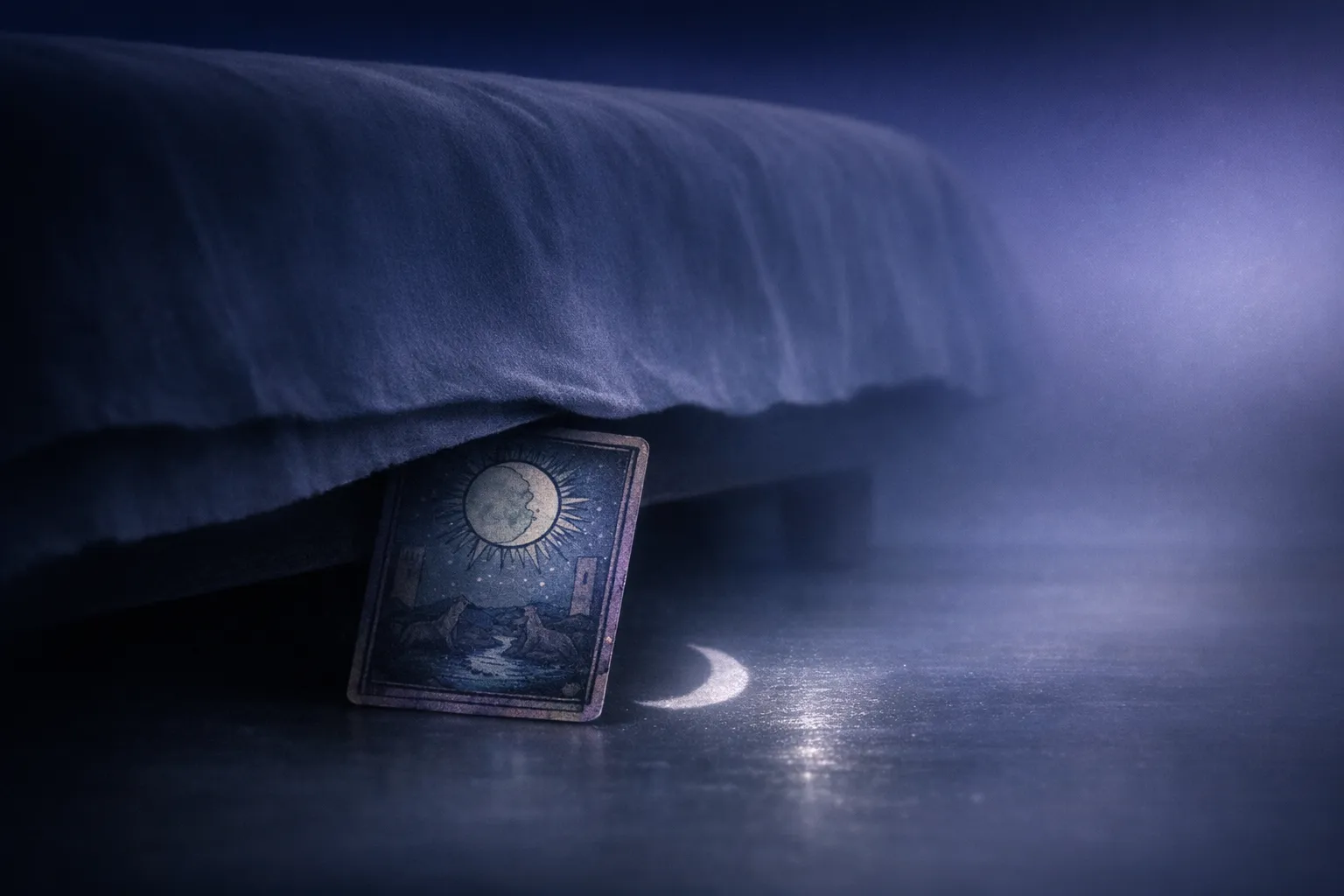
Dancing with Shadows
Surprising fact: in many old folk traditions, the “monster under the bed” wasn’t a creature to banish – it was a house spirit signaling a message you kept ignoring. In other words, the growl wasn’t a threat; it was a notification. Picture the anchor: you wake from a dream, a shadowy figure breathing beneath the mattress springs. Morning light. And there sits the Moon card on your nightstand, as if some velvet-handed librarian slipped it from the deck while you slept. The uncanny pairing feels like a prank from the universe, but it’s actually a fluent conversation in symbols.
I’ve come to think of the monsters as your subconscious narrators – part stagehand, part director – using costumes and sound cues to nudge you toward a plot twist. They embody the things we don’t say out loud: anxieties about safety, ambition, desire, or even the courage it takes to rest. A lurking shape? Perhaps your own talent waiting for permission. A toothy maw? Maybe a boundary you don’t believe you’re allowed to set, drooling for attention. The Moon in tarot mirrors this terrain. It’s the card of foggy paths and animal instincts, where intuition walks on soft paws. In a reading, the Moon asks for curiosity over certainty. In a dream, it flips the hallway lights to dim and lets silhouettes speak.
Here’s the myth I’d like to retire: nightmares mean something’s wrong with you. More often, they mean something’s asking to be witnessed by you. The psyche is not a courtroom; it’s a rehearsal room. Monsters stomp around to help you hear the echoes. When you begin to listen – no spotlight, no interrogation – those stomps become choreography. You start to recognize the rhythm of the message: Am I safe? Am I seen? Am I choosing this? The moment you treat the dreamworld like a midnight theater rather than a crime scene, the shadow under the bed stands up, bows, and introduces itself by name.
Monsters as Messengers
First, let’s debunk the two biggest monster myths: one, that a frightening dream equals a literal prophecy; two, that the creepiest figure is always the villain. The dreaming mind loves metaphor more than memoir. That slithering shape might be your intuition taking its first wiggly steps. The giant with echoing footsteps might be the size of your next decision. If the subconscious were a radio station, monsters are the bassline – felt first, then understood.
Consider a common dream: something swallows you whole. Traditional fear translation says, “You’re being consumed by life.” But sometimes, it’s the opposite: you want to be enveloped by the thing you love – a calling, a relationship, the next chapter – and the fear is the thin membrane between you and surrender. Or the foot-grabbing ghoul under the bed? Perhaps your energy management is begging for attention. Feet carry us. If the monster grabs them, it’s asking, “Where are you going? And who decided the route?”
Monsters also wear masks made from our own unclaimed traits. The bone-rattling laugh you hear? That could be your sense of power, locked in the closet labeled “too much.” The spider with luminous eyes? Your pattern-maker brain, trying to connect silk-thin threads you keep dismissing. A key question when you wake: what does this creature do well? Because that’s what it’s teaching. Claws? Boundaries. Wings? Perspective. Scales? Resilience. Fangs? Discernment – the ability to separate nourishing from numbing.
Humor helps. A dream ogre barreling through a cubicle farm is dramatic, yes, but it’s also a cartoon. If you can sketch it, name it, or give it an unlikely talent (tap-dancing ogre, anyone?), you loosen fear’s grip and tighten focus on the message. The subconscious isn’t asking you to fight a beast; it’s inviting you to hire it. Bring the monster into your creative team. Ask it to brief you on what the waking mind won’t schedule on the calendar.
The Tarot’s Hidden Pathways
Tarot is often mistaken for a fortune-teller’s megaphone, when it’s more like a dream interpreter’s deck of post-it notes. The 78 images have a habit of echoing what the psyche is already whispering. Think of a tarot spread as floor lighting on the Moon card’s foggy path: not a blueprint, but a glow that shows where your feet won’t trip. When you pair a dream monster with a tarot archetype, you essentially give the creature a translator – and suddenly the growl becomes a sentence you can understand.
Take that shadow beneath the bed. Pair it with the Moon and you get a syllabus: trust the hunch, admit the ambiguity, follow the animal sense. Pull the Hermit, and the shadow says, “Step back from the noise to hear me fully.” Pull Strength, and it purrs, “Gentle courage beats brute force.” The Tower with a falling figure? Not punishment; permission to release a structure that’s outlived you. The Devil, with its chains that are loose if you look closely, whispers about attachments that pose as comfort but pinch when you move.
A quick note on jargon: “reversed” cards simply mean the energy is turned inward or asks for course-correction; it isn’t bad news, just a different key. And “suits” (Wands, Cups, Swords, Pentacles) map onto familiar energies – fire, water, air, earth – useful anchors for dream textures. If your dream is drenched in ocean imagery, Cups might wade in with emotional fluency. If the monster is fast-talking and sharp-edged, Swords might be narrating a thought pattern asking for a rewrite.
The fun twist is this: dreamwork plus tarot is less about decoding and more about dialoguing. You ask, the card answers, you respond, the dream replies the next night. It’s a correspondence, not a verdict. Over time, monsters retire their masks because they no longer need them. The message becomes a regular memo, not a jump-scare. And your nights turn from chase scenes into rehearsals where your next confident step is cast, costumed, and ready for opening night.
Reading the Monster: A Step-by-Step Walkthrough
Let’s turn the lights up – softly. Here’s a compact walkthrough to make friends with whatever snarls from the underside of sleep.
-
Name the creature before coffee. Don’t default to “scary thing.” Try “Underbed Archivist” or “Velvet-Eyed Climber.” Specific names shift your brain from panic to curiosity.
-
Sketch or describe its standout features. Claws, whiskers, extra knees – note them. Ask: what life skill does each feature symbolize? Claws = gripping a goal. Extra knees = flexibility. Whiskers = subtle sensing.
-
Pull one tarot card. Shuffle while holding the dream in mind. Ask: “What role is this monster playing for me?” Let the card be an answer, not an accusation. If you pull the Moon, you’re in the realm of instincts and mirages. The Chariot? Time to steer, even while nervous. Four of Swords? Rest, strategically – rest is an action.
-
Check the emotional weather. What did you feel before the monster appeared? Interest? Annoyance? Relief masquerading as fear? Feelings timestamp the message. A startled laugh can mean “This is familiar and I’m finally seeing it.”
-
Translate action into advice. If the creature tried to tug you under, consider where you’re dipping only a toe in real life. If it peered out but didn’t pounce, ask where you need permission to observe before acting.
-
Create a handshake, not a treaty. Offer a small ritual object on your nightstand – a stone, a ribbon, a note with one brave sentence – so the subconscious knows you’re taking the memo. Rituals are just meaningful reminders with flair.
-
Close the loop the next night. Before sleep, tell the monster-narrator, “More details, please.” You’d be surprised how many dreams come back with footnotes. And if you pull another card in the morning, you’re building a serial: episode by episode, fear transforms into a storyline with momentum and heart.
Debunking the Big Dream-Tarot Myths
Let’s swing our flashlight into the dusty corners and shoo out a few rattling myths.
-
Myth: Nightmare equals omen of doom. Reality: Nightmares are intensity, not indictment. They flag something potent that needs gentle unpacking. Tarot cards don’t confirm catastrophe; they outline themes. The Ten of Swords looks dramatic, sure, but it’s also the dawn waiting offstage. The stagehands are already rolling out a sunrise backdrop.
-
Myth: The scariest image is the truest message. Reality: Volume isn’t honesty. Sometimes the tiny detail – a soft hum, a key under a rug, a moth tapping the window – is the luminous clue. If you pull the Page of Pentacles after a loud dream, the real note might be, “Start small, stay steady.” The monster was there to get your attention; now listen to the whisper.
-
Myth: Tarot and dreams strip away your free will. Reality: They sharpen it. Guidance highlights options you might otherwise overlook. The Lovers isn’t only hearts and harp music; it’s value alignment. Waking choice is the plot twist only you can write.
-
Myth: The Moon card means deception. Reality: It means mist. Mist asks for different vision: less headlamp, more inner echolocation. The monster under the bed is not lying to you; it’s speaking in silhouettes because that’s the language of liminal space. Think of it as learning to read by candlelight. You notice different letters.
-
Myth: If I’m brave, I should confront the monster. Reality: Try befriending first. Even Strength shows a gentle hand on the lion’s jaw, not a wrestle. Courage is consent-based. You can set the pace. Curiosity is a flashlight that doesn’t blind.
If you hold onto one thing, let it be this: symbols are elastic. They meet you where you are and stretch without snapping. Your dream-monster and your tarot deck will collaborate in the dialect you actually speak – humor, images, music, lists, quiet. You don’t have to “get it right.” You have to get it yours.
Waning Crescent: The Dreamer’s Doorway
The waning crescent is that thin silver grin before the moon goes dark – energetically, it’s the hush between exhale and pause. In symbolic terms, this is compost time: what you’ve learned this month gets mulled, sifted, reabsorbed. It’s also prime scheduling for monster diplomacy. Why? Fewer distractions. The sky, like your psyche, prefers whispers now. If the full moon is a drum circle, the waning crescent is a librarian with soft shoes, guiding you to the stacks where your bravest questions are shelved.
Dreams during this phase often feature low light, corridors, or thresholds. Nighttime omens feel more like librarians too: they hand you a label for an unnamed feeling. The monsters behave differently – less chase, more watchful presence. They wait to see if you’ll notice the index cards in their claws. Pull a tarot card in the morning and you’ll find the archetypes presenting their quieter faces. The High Priestess doesn’t announce; she nods. The Star doesn’t glitter loudly; it glows like embroidery on dark fabric. Even the Tower’s lightning might flicker as insight rather than catastrophe.
Here’s a gentle mini-ritual tailored to this phase:
- Before bed, slide a small object under your mattress edge – something that symbolizes what you’re willing to release. A worn-out to-do list. A paperclip holding stale worries. Name it: “This goes to compost.”
- Place a single tarot card facedown on your nightstand. Don’t look yet.
- Upon waking, write three lines about your dream monster. Then flip the card. Let the image finish your third line, as if the card is co-authoring your note.
- Thank the creature aloud by its chosen name. Gratitude lowers the drawbridge between worlds.
This is the season of less-is-more magic. If the message feels incomplete, that’s by design. Waning crescents teach the elegance of ellipses. You’re not chasing the beast down the hall; you’re reading the margin notes it left under the bed. The next cycle will bring volume. For now, savor the hush. And if you catch that Moon card winking on your nightstand again, know you’re right on time, walking with your narrators through the delicious mist of becoming. If you’re curious how this phase threads through your specific symbol-weave, a thoughtful psychic reading can add a companion voice to your own.
The Bed Becomes a Bridge
By now, the underbed is less a lair and more a library table. What began as a skitter in the dark has turned into syntax. You ask better questions. Your deck answers like a friend who knows your tells. And the monster? It upgrades from jump-scare actor to dramaturg – guiding tone, refining scenes, cutting subplots that drain your momentum. Together, you’re revising the script.
Let’s imagine one last tableau: you wake after a dream where a velvet-limbed crawler counted your heartbeats with perfect patience. No chase, no bite, just counting. On the nightstand, the Four of Pentacles greets you, then the next day the Eight of Cups slips out during lunch. The crawler teaches secure containment – how not to leak energy. The cards nudge you toward responsible holding (Four) and soulful leaving (Eight). Not a contradiction. A choreography: hold what matters, walk from what doesn’t. Your day, once a flurry of unresolved scenes, simplifies into a single clear cut.
If you worry you’ll misread a card or a creature, remember: symbols grow with repetition. The more you meet them, the more they meet you. Try making a “monster deck” of index cards – one creature per card, each with a talent: The Archivist (keeps receipts), The Echo Cat (finds lost signals), The Tangle Whale (surfaces patterns). When a dream visits, draw your monster card and a tarot card. Let them duet. The result is rarely literal, often useful, and occasionally hilarious – which, by the way, is a sacred state. Laughter opens the ribs so the heart can listen.
And what of fear? It doesn’t vanish; it evolves. Fear becomes a compass: point of interest, not verdict. When the Moon trails silver along the baseboards, you don’t brace – you breathe, you listen, you check under the bed as if opening a beloved book. The monsters slip their scripts across the floor. You pick them up, pencil your edits in the margins, and set them back with a smile. Then you rise – wiser, softer, a little gleeful – and step into your day carrying exactly what the night wanted you to know. The bridge holds. The path glows. The narrators hum their basso continuo, and you – wide awake – write the next scene.

